

You're standing at the edge of the water with a candidate who has never worn baptism clothing before. The robe in your hands looks right on the hanger, white and long, but you still don't know whether it will cover once it's soaked, whether the hem will trip them on the steps, or what they should have on underneath.
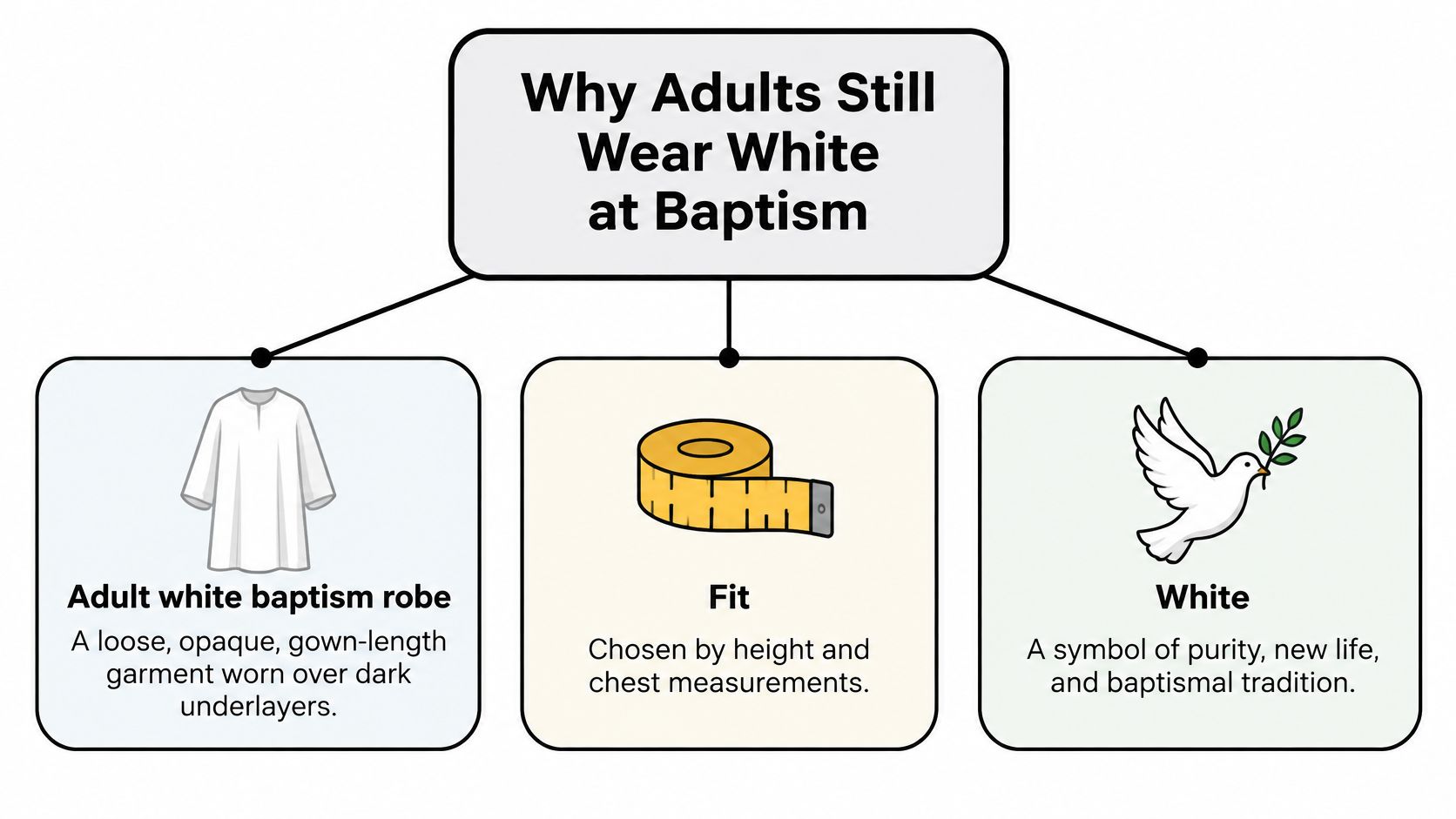
An adult white baptism robe is a loose, opaque, gown-length garment worn over dark underlayers. You choose it by height and chest, not by a letter on a tag, and white is the traditional sign of new life.
Why Adults Still Wear White at Baptism
An adult walks down the steps while the congregation watches for a visible sign of a new start. The white religious robe does that work in a single glance. It isn't a fashion choice. It's the garment the church has used for centuries to say this person has been washed and clothed in a new life.
From the early centuries, the newly baptized received a white garment because they had "put on Christ" and risen with Christ. The Vatican's account of how baptism is celebrated ties that clothing to new life received through Christ and the Holy Spirit. In a 2018 general audience, Pope Francis said dressing the baptized in a new white garment appeared natural "from the first centuries," because the garment stood for that new life. Catholic teaching also reaches for related images: enlightenment, rebirth, and a "garment of immortality."
A clean robe is part of the sign
The rite doesn't stop at handing over the cloth. The newly baptized are told to keep the garment unstained, a call to preserve Christian dignity. The United States Catholic Catechism for Adults connects that garment with being clothed in Christ's protective love and with the image of robes made white. That's why a clean robe matters for adults as much as for children. A yellowed, damp, or sheer gown undercuts the sign the congregation came to see.
Practical rule: White remains the most recognizable baptism color across traditions that immerse or pour, even when the theology and the service format differ.
It is not a universal dress code. A French Catholic liturgy note explains that, after the Second Vatican Council, presentation of the white garment was made optional for adults and for school-age children. The same note says the symbol is especially clear with immersion: old clothing comes off, and a white garment goes on. When a full gown is impractical, a Catholic explanation of sacramental dress notes that a white stole or bib can carry the meaning. If you're tracing those images back to Scripture before you brief a class, Bible study tips and context from Scroll With God is a useful companion. For a fuller look at guests and color, see whether you can wear white to a baptism.
Adult baptism robes are the pillar this decision sits on. Baptism garments have to be measured, layered, ordered, and washed. Those four choices decide whether the white robe stays dignified in the water and affordable over years of services.
How to Size a White Baptism Robe for Adults
Letter sizes are the wrong tool for a white baptism robe for adults. A shirt labeled large tells you almost nothing about gown length once the cloth is wet.
| Height or build | Proportion | Measure | Length and ease target |
|---|---|---|---|
| Up to 5 ft 3 in | Short | Height and chest; hip if the cut is close | Hem clears the floor when dry so wet cloth does not pool |
| 5 ft 4 in to 5 ft 7 in | Regular | Height, chest, and shoulder | Loose walking ease; sleeves cover the wrist when arms lift |
| 5 ft 8 in to 6 ft 0 in | Regular to tall | Height and chest | Gown-length coverage that still allows climbing steps |
| 6 ft 1 in and taller | Tall | Height first, then chest | Extra length without letting a wet hem ride high |
| Chest above 52 in | Extended | Chest, shoulder, and hip | Movement ease beyond a letter size; do not assume one length |
ASTM D6240 textile measurement tables cover adult male chests from 34 to 52 inches in short, regular, and tall proportions. Those tables exist so a pattern can add ease for fabric, movement, and styling. Standardized measurements also cut the confusion that comes from a nominal size alone. For religious attire for adults, that is the whole point. A label hides the two numbers that set a baptism gown: height and chest.
Read the row before you order
Collect height first, then chest. Add hip or waist when the cut is close through the body. Length comes from the height band.
- Short builds, up to 5 ft 3 in: The hem should clear the floor while the cloth is still dry. Wet fabric gains weight and pools. A pooled hem is a trip hazard on wet tile.
- Regular heights, 5 ft 4 in to 5 ft 7 in: You want walking ease and sleeves that still cover the wrist when the arms lift for prayer or for help out of the water.
- Regular to tall, 5 ft 8 in to 6 ft 0 in: Gown-length coverage has to leave room to climb steps. A hem that looks elegant on a fitting-room floor can catch a step edge.
- Tall, 6 ft 1 in and up: Start with height, then check chest. Extra length should not come from a robe so short that a wet hem rides up.
- Chest above 52 inches: This is extended ease, not a bigger letter guessed from a dress shirt. Measure chest, shoulder, and hip, and don't assume one universal length.
Stock short, regular, tall, and extended options. One robe length cannot serve a whole adult congregation.
The same height-and-chest method works for women and for unisex cuts, but the ASTM tables are built on adult male measurements. Confirm the result against the maker's own women's chart. Never map a men's letter size onto a women's cut. For a close-fitting style, record the hip so the chart is read correctly. If you want a clear measuring sequence for a structured garment, get jacket sizing right with Kilts4Less and use that same discipline here: one person measures, one person writes the numbers down.
An Adult White Baptism Robe is cut loose, with long sleeves or gown-length draping depending on the version, in a fabric meant to be rinsed and washed between immersions. Loose is not the same as unmeasured. You still match the height band.
The three-move fitting test
Have the wearer put the adult baptism gown on over the clothes they'll baptize in, then do three moves.
- Raise both arms overhead.
- Take three steps, including a turn.
- Sit, then stand.
If the chest pulls, change the ease, not the speech you planned to give. If the hem drags, move to a shorter height band. If the wet-length risk is obvious even while the cloth is dry, it will be worse in the pool.
Fabrics That Stay Modest After Immersion
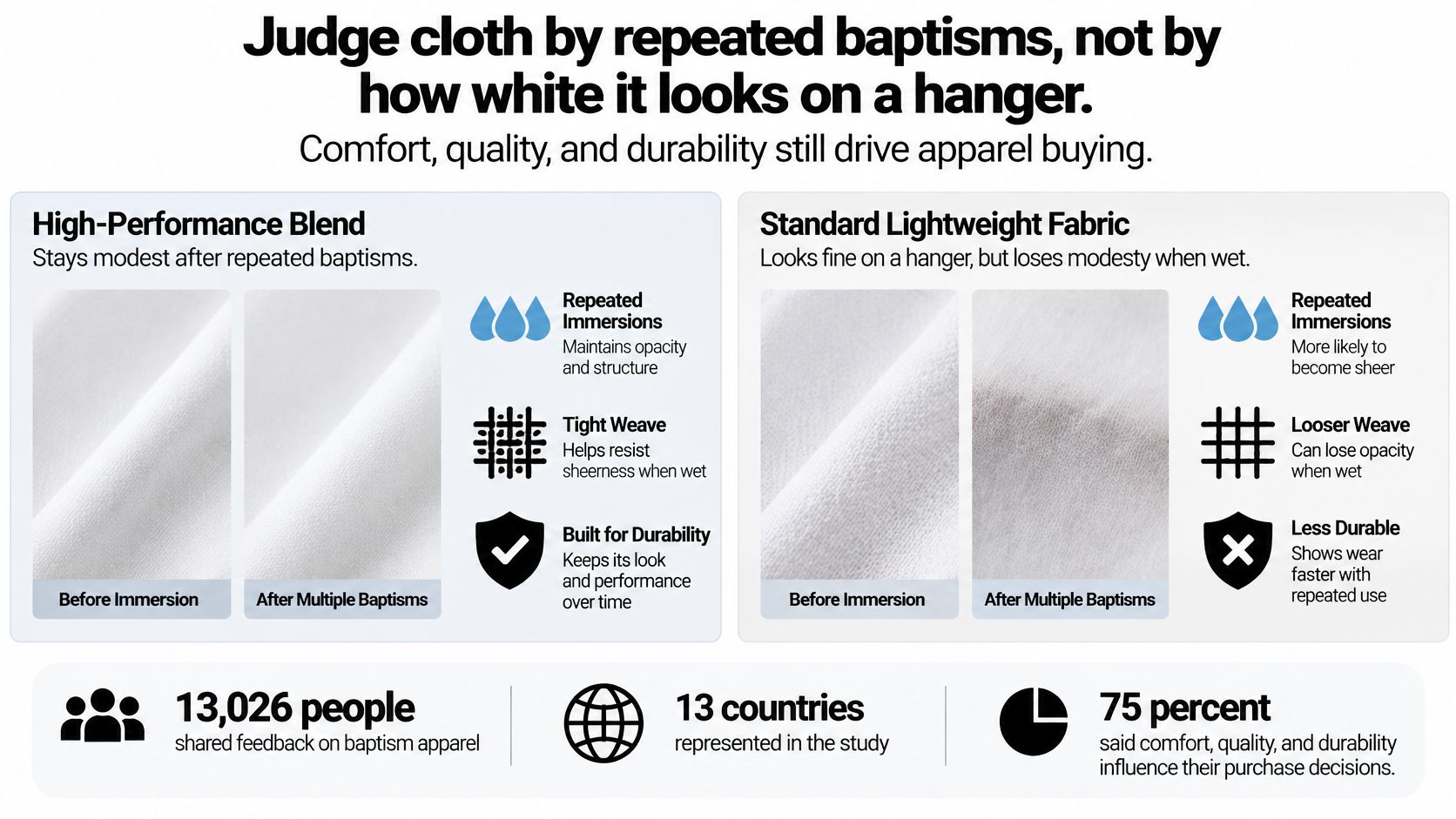
Judge cloth by repeated baptisms, not by how white it looks on a hanger. Cotton is not automatically the better church robe.
Comfort, quality, and durability still drive what people buy. Research covering 13,026 people in 13 countries found that 75 percent expressed interest in sustainable clothing, while 49 percent rated cotton more sustainable than polyester or rayon, as reported by Textile World. Laboratory durability work complicates that preference. Synthetic-containing garments were disproportionately represented among the most physically durable items tested, and price was not a reliable guide to how long a garment lasts.
European textile consumption rose from 17 kg per person in 2019 to 19 kg in 2022. Replacing a cheap robe every season is its own waste. A congregation that baptizes often should score each cloth on wet opacity, cling, dry time, mildew resistance, the hottest wash it can take, seam and hem strength, and whether embroidery survives that wash.
| Fabric | When wet | Dry time and durability | Laundry limit |
|---|---|---|---|
| Matte opaque synthetic | Stays more covering and clings less if the cloth is truly opaque | Usually fast drying; synthetics were over-represented among the most durable lab-tested garments | Follow the label; high heat can harm finishes |
| Cotton | Breathes, but can cling and turn sheer | Slower drying; durability varies and is not guaranteed by the fiber name | Often tolerates hotter wash; still confirm shrinkage |
| Cotton-poly blend | Middle opacity and cling | Middle dry time; a practical reuse compromise | Wash at the lower limit of the two fibers |
| Any fiber with embroidery | Same as the base cloth | Stitching can outlast or fail before the cloth | Thread and backing must match the wash temperature |
Read the fibers one row at a time
Matte opaque synthetic is usually the modest default for immersion. If the cloth is opaque, it stays more covering and clings less. It tends to dry fast. High heat can strip a water-resistant finish, so the care label outranks a hope that "polyester can take it."
Cotton breathes, and many people trust it because it feels familiar. Wet cotton can cling and turn sheer. Drying is slower, which matters when the next service is the same afternoon. Hotter water is often possible, but shrinkage is not theoretical. A gown that fit on Sunday can sit above the ankle after three hot washes.
A cotton-poly blend is the middle path. Opacity and cling sit between the other two, and so does dry time. Wash at the lower limit of the two fibers. If the polyester side can't take the cotton's hottest cycle, the blend can't either.
Embroidery doesn't change the base cloth's wet behavior, but the thread and backing can fail first. Order stitching that matches the wash you will run.
A water-resistant finish only helps if it survives the church's real wash. "Quick-dry" on a hangtag is not a test. Hold a wet sample to a window. If you can see a hand behind it, it isn't modest enough.
Weighted hems are a separate modesty tool when light cloth floats. Our note on weighted baptismal robes explains why some gowns need that help. The video below shows how a soaked white garment behaves once someone is in the water, which is the test a hanger can't give you.
Total cost is replacements plus robes that yellow or go sheer, not the tag price alone. The robe with the lowest impact over years of church use is the one that stays opaque, dries fully, and doesn't get thrown out after a season.
How to Wash and Store Robes Between Services
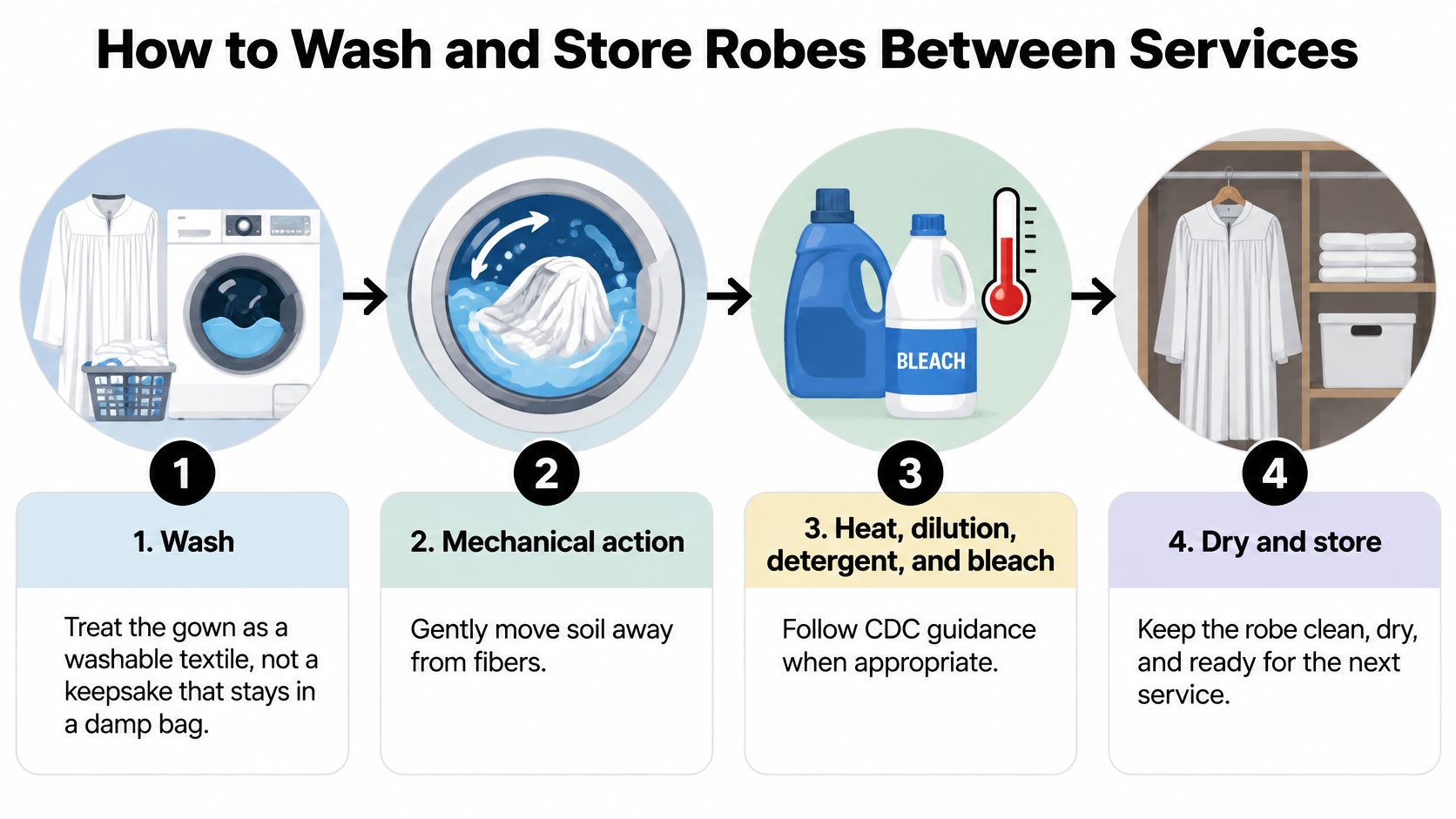
Treat the gown as a washable textile, not a keepsake that stays in a damp bag. A white robe that smells like the pool has already failed the next candidate.
CDC laundry guidance explains that laundering removes microorganisms through mechanical action, heat, dilution, detergents, and, when appropriate, bleach. The result is hygienically clean textiles, not sterile ones. A commonly recommended healthcare hot-water process is 160°F (71°C) for at least 25 minutes. That figure is a hospital reference. The robe label overrides it. Hospital heat can shrink a gown, fade a finish, or cook embroidery.
What to know before you buy
Before the first order, the church should have four facts from the maker: maximum wash temperature, bleach compatibility, drying method, and expected shrinkage. Fabric, dye, seams, closures, and embroidery all have to survive that cycle. If the spec sheet doesn't say, don't guess with a hotter machine "just to be safe."
White shows soil. Wash after every immersion. Don't hang a damp gown in a closet and call it stored.
A numbered routine between services
- Rinse pool or baptismal water soon after the service, before chlorine or silt sets.
- Keep used robes in a separate bin from clean ones. Don't restack them on the same table.
- Close zippers, and turn embroidery inside if the label says to protect it.
- Wash with detergent on the hottest setting the label allows. Add bleach only when the maker allows it.
- Dry in a machine or on a line until hems and seams are fully dry. No cool damp left in the folds.
- Store only dry robes, hung or folded in a ventilated space.
A mildew smell means the gown was put away wet. Washing it later doesn't undo a Sunday when someone had to wear it.
Reuse is appropriate when seams, color, and any water-resistant treatment still pass that cycle. If the hem twists, the white has gone gray, or the finish no longer beads water, retire that robe. Baptism robes are meant to be used again. They aren't meant to be used past the point where they stop looking like the sign you bought them to be.
What to Wear Under a White Baptism Robe
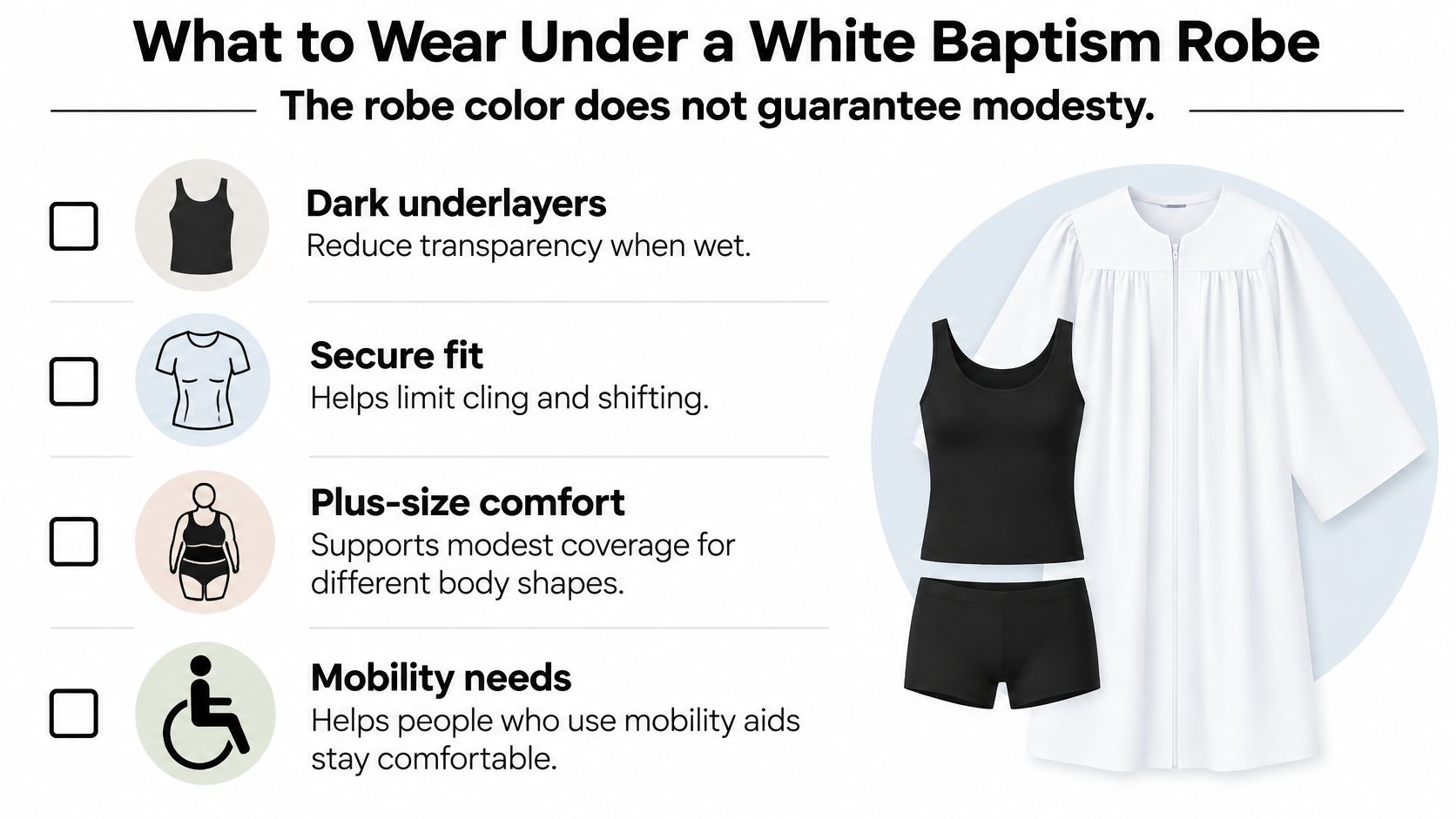
The robe color doesn't guarantee modesty. Wet white cloth can turn more transparent, cling, or shift. That shows up fast for plus-size candidates, people who wear compression garments, transgender candidates, and anyone who can't change in a shared room.
Most checklists stop at "wear a swimsuit." Guidance on what to wear for a baptism is a starting point, but opacity, closures, and the walk out of the water have to be planned together. Church policy overrides general advice. If your congregation asks for a specific layer, pack that layer.
| Underlayer | Opacity when wet | Cling and shift | Best fit for |
|---|---|---|---|
| Dark swimwear | Hides best under white | Low when fitted | Most candidates, the default choice |
| Skin-tone swimwear | Can show through white | May cling and outline the body | Only where the church rule allows it |
| Compression shorts | Opaque when the fabric is thick | Stays in place | Candidates who use compression garments |
| Modest athletic top | Adds torso coverage | Low if it is fitted and stays tucked | Modesty-focused or plus-size candidates |
| Quick-dry briefs | Thin, so they need a darker layer over them | Avoids a soaked cotton layer that sags | Layer under dark swimwear |
Choose the layer, then plan the exit
Dark swimwear is the default. It hides better than pale or skin-tone fabric under white. Compression shorts stay put when a looser suit would shift. A modest athletic top adds torso coverage for candidates who want more than a swimsuit. Quick-dry briefs go under the dark layer so you aren't dealing with soaked cotton that sags. Skip heavy street clothes under the gown. Jeans and a T-shirt hold water, drag the hem, and make the climb out harder.
The robe still has its own job. It needs opaque wet-safe cloth, room through the shoulders, a closure that stays shut, and a hem that stays down when someone is helped from the water. A white robe alone is not the modest outfit. The underlayer and the changing plan often matter more than the color.
For baptism outfit ideas that include family and guests, our guide to what to wear to a baptism covers the people who stay dry. The candidate's list is shorter and stricter.
Five steps before the service
- Confirm the church underlayer rule in writing, not in a hallway conversation.
- Pack dark quick-dry layers, plus a spare if the first set gets soaked early.
- Test that the robe closes over those layers, including when the arms are raised.
- Assign a private changing space. A bathroom stall shared with the congregation is not a plan.
- Set a large towel, a dry wrap or second robe, non-slip footwear for wet tile, and a full change of clothes where the candidate exits. Add a helper when mobility is limited.
The outfit is robe plus underlayer plus exit plan. Miss any one of the three and the walk back to the seats is the part people remember.
Ordering One Robe or Outfitting a Church
A single adult robe and a church order have different needs. An individual can choose one gown and, if desired, request custom embroidery. A congregation may need several adult sizes, youth or children's robes, and separate garments for clergy. Before ordering, decide who will wear each robe and how the garments will be cared for between services.
Pastor robes are made for clergy, while adult baptism robes are for candidates. A baptismal stole is designed to be worn with an adult robe. Custom embroidery can reflect a church's identity; confirm the wording and placement before ordering.
How 2025 published prices compare
Published 2025 church-supply pages for adult white baptism robes ranged from roughly $30 to $160, depending on fabric, embroidery, and order size. Treat that as a budgeting range, not a current quote. Compare the same specifications and ask sellers for written pricing before placing an order.
For quantity planning, see this guide to wholesale baptismal robes. It can help churches consider a larger order alongside individual robe needs.
The admin checklist
- Estimate how many adult robes the church needs, including a small reserve for additional candidates.
- Record each candidate's measurements and use the size chart to select a fit.
- Confirm the church's garment and embroidery preferences before ordering.
- Decide where robes will be stored and how they will be washed and dried between services.
- Order pastor robes separately from candidate gowns.
- Approve embroidery wording and placement before production.
- Check that the order quantity fits the church's available laundering and storage capacity.
A clear count, size record, and care plan make it easier to prepare robes for one candidate or a full service.
Frequently Asked Questions About Adult Baptism Robes
What does the white baptism robe symbolize?
It shows that the baptized person has put on Christ and risen with him. The color is a sign of new life, Christian dignity, and purity, not a costume. A clean, opaque gown is what lets the congregation read that sign during the service.
Do adults need to wear special garments for baptism?
Not always. In some Catholic rites the white garment is optional for adults, and a white stole can carry the meaning when a full gown is impractical. The church's own rite decides. The candidate still needs opaque, wet-safe underlayers and a full change of clothes afterward.
What size baptism robe should I buy?
Measure height and chest, then choose the height band so the hem clears the floor when the cloth is dry. A letter label from street clothes won't set gown length or the ease you need to lift your arms in the water. If the cut is close, add a hip measurement before you order.
Can baptism robes be reused?
Yes, when seams, color, and any water-resistant finish still survive the church's wash cycle. Wash after every immersion and dry the gown fully before it goes back on a shelf. A robe put away damp isn't ready for the next candidate, even if it looks white from across the room.
Where can churches purchase baptism robes in bulk?
Choose a seller that lists bulk pricing or will quote by quantity, and ask for a written quote that includes embroidery text and wash limits. We outfit churches with adult, youth, and pastor robes plus stoles, so the adult stack, the children's stack, and the leader's robe don't get mixed into one guess. Count candidates, add two spare adult robes, and confirm you can launder that many before the next service.
Can a pastor wear a candidate robe?
No. Pastor baptism vestments are cut for the leader and keep that role visible beside the people being baptized. Candidate gowns stay with the candidates. A stole can be added to an adult robe, but it doesn't turn a candidate gown into clergy dress.
Confirm Fit and Order the White Robe
Order after three checks, not before. Confirm the height band and the chest ease. Confirm the underlayer rule your church uses. Confirm whether the person leading needs a clergy robe of their own.
We make adult baptism robes, youth and children's robes, pastor robes, and stoles for that split. Adult black, maroon, navy, and white baptism robes are each priced at $22.95. The white gown is a loose fit, with long sleeves or gown-length draping depending on the version, and it's made to be rinsed and washed between services. Churches that want a name on shared inventory can use custom embroidered baptism robes.
If you lead the service, use a premium white baptismal pastor robe rather than a candidate gown. Candidates start with the white baptism robe. Use the numbered checklist from the ordering section as your order form: counts, measurements, underlayers, a private changing room, separate vestments, approved embroidery, two spares, and a laundry plan that finishes before the next baptism.
Baptism Robes supplies adult, youth, children's, and pastor baptism robes, plus stoles, so a white robe for adults can be sized, layered, and washed without guessing from a letter tag. If you're outfitting one candidate or a full baptism Sunday, visit Baptism Robes and match the gown to the height, the underlayer, and the person leading the service.