

Yes, the person being baptized should wear white when the church expects it, and guests can wear white conditionally when the outfit stays modest, doesn't blur who the candidate is, and fits local church norms. That split by role is the whole answer, and it's why a flat yes or no misleads almost everyone who asks.
Why the Question Is More Complicated Than It Sounds
You're standing in front of the closet on baptism morning, holding a white dress or shirt, and you're not sure if you're about to honor the day or steal it. Parents hit the same wall when shopping for children's baptism apparel, and adult candidates hit it when nobody told them whether the church hands them a robe. I hear this confusion constantly, and it comes from treating one question as if it had one answer.
It doesn't. When people ask can you wear white to a baptism, they're really asking three different things. Are you the candidate, a parent or godparent, or a guest? What tradition is running the service? Will water touch what you're wearing?
The Three Questions That Decide It
- Your role: White means one thing on the candidate and something else entirely on a guest in the third pew.
- Your tradition: Catholic, Orthodox, and evangelical churches use the same color at different moments in the rite.
- Your water: Full immersion, pouring, and sprinkling each demand different baptism clothing, coverage, and fabric choices.
Get those three sorted and the wardrobe decision gets simple. You'll know whether you need baptism robes at all, what to ask your pastor or parish office before you buy anything, and which white outfit ideas will work without embarrassment. My bias is practical. Respect the tradition, protect modesty, and don't spend money until the church tells you what it supplies.
Don't shop first and ask later. One two-minute call to the church prevents most baptism clothing mistakes.
That order matters for candidates especially. If the congregation provides a shared robe, your job is choosing what goes underneath it, not hunting for a gown you'll wear for ninety seconds.
The Symbolism Behind White at Baptism
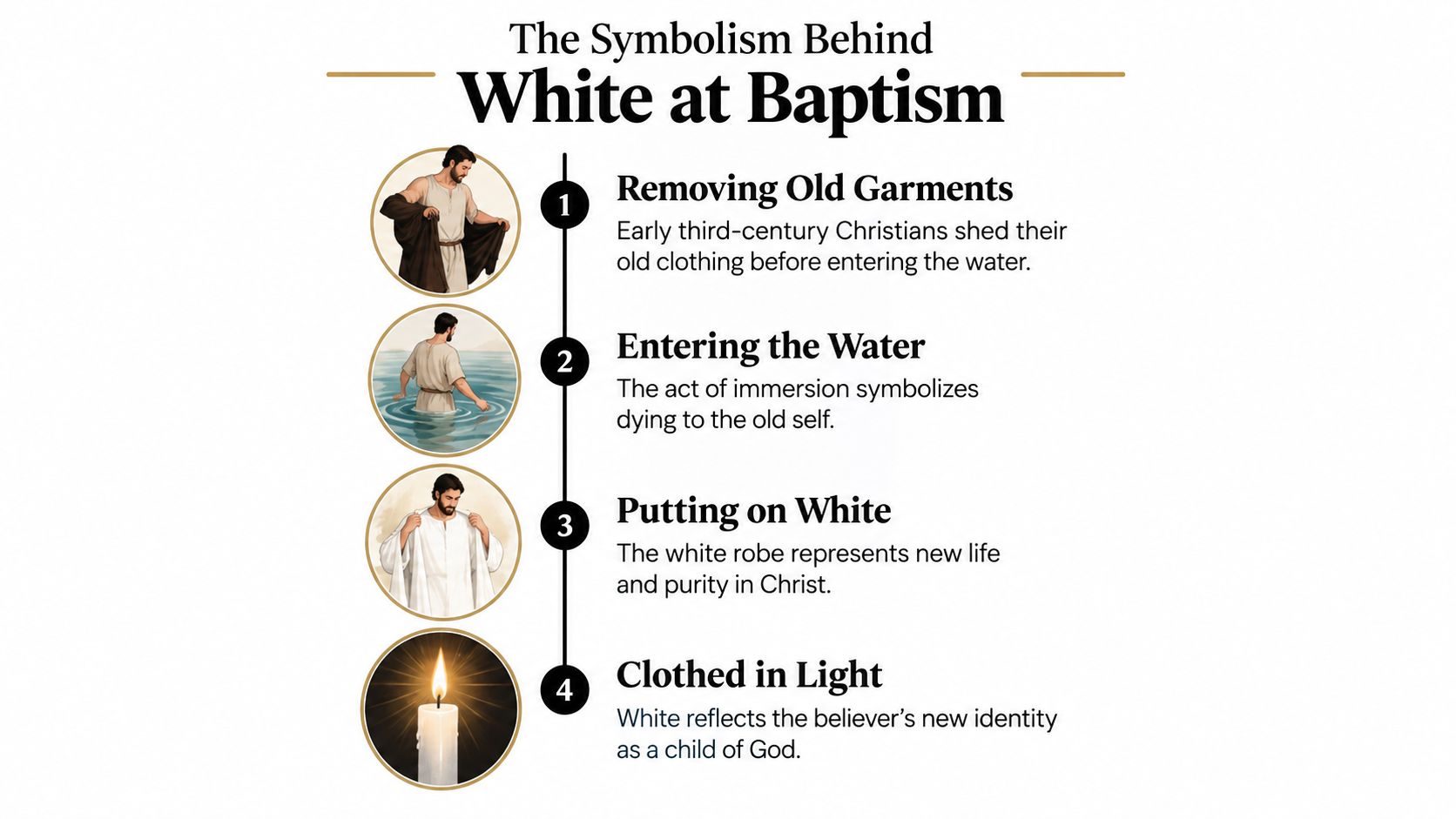
White at baptism isn't borrowed from weddings. It's older than most wedding customs and it carries a specific job. Think of it less as a fashion choice and more as a uniform for a new role, the way a graduate's gown signals a status the person didn't hold the day before.
The practice is documented early. A Catholic liturgical history citing the Tradition Apostolica describes a baptismal practice around the year 215 in the early Christian account of candidates removing old clothing and putting on a new white garment after emerging from the water. From the fourth century onward, newly baptized Christians commonly stayed in white through the seven days after Easter, the "week in white" or in albis, while receiving further instruction.
What the Garment Actually Says
Catholic teaching puts words to the symbol. The United States Catholic Catechism for Adults explains that the white garment signifies the newly baptized person has "put on Christ" and risen with him, clothed in Christ's protective love, in the catechism's teaching on the white garment and keeping it unstained. That's why I tell families a white religious robe isn't decoration. It announces new life and moral renewal in a language the whole room reads instantly.
This is also why photographers love baptism mornings and why families keep the garment. If you're planning portraits around the day, the portfolio work of an Atlanta wedding photographer Liz by Design shows how white garments photograph in bright church light, which is worth a look before you choose shiny or heavily textured fabric. For the candidate, white is the message. For everyone else, white is just a color that needs to stay in its lane.
How Different Christian Traditions Treat White
Same color, different timing. That's the mental model you need. Traditions disagree less about whether white belongs and more about when it goes on the body relative to the water, and that timing changes what you buy.
The comparison below lays out the four patterns you'll most likely encounter.
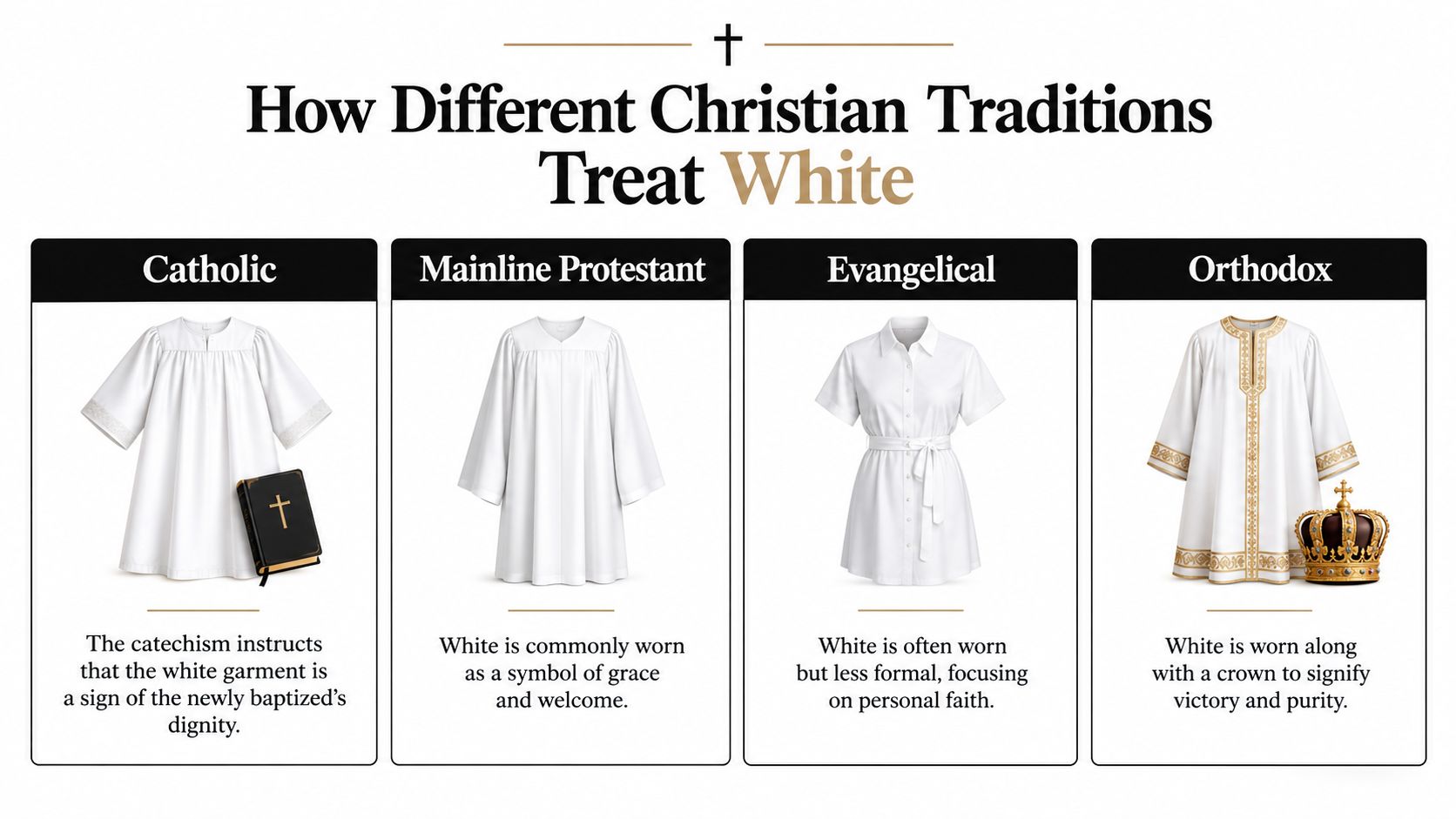
In Catholic practice, the minister presents a white garment and a candle after baptism, and white clothing isn't generally required for sacraments beyond that ritual moment, as Catholic guidance on whether white is required for sacraments makes clear. The garment can even be omitted when circumstances require it. Infants often arrive already dressed in white, which flips the sequence entirely.
Mainline and evangelical churches frequently handle it differently. The St Andrews Encyclopaedia of Theology notes that in one initiation sequence the baptized person is dressed in a white gown after baptism, while the encyclopedia's account of baptismal gown timing alongside anointing shows infants may be presented in the gown from the start. Many evangelical congregations hand the candidate a shared robe to wear over regular clothes for immersion.
Orthodox practice extends the garment beyond the service itself. In Eastern Orthodox and Byzantine traditions, the newly baptized may wear the garment for eight days before a special rite removes it, a pattern described in the overview of baptismal clothing across traditions. Families exploring that heritage will find useful context in the guide to Greek Orthodox christening customs.
The video below walks through how these services unfold, which helps if you've never seen your tradition's version.
My recommendation stays blunt. Ask your local church what it expects before you purchase a single adult baptism gown or christening outfit.
Candidate Versus Guest Versus Clergy
Find your row and stop worrying about everyone else's. Role clarity solves most of the anxiety around baptism outfit ideas, because each role carries a different relationship to the color white.
White at Baptism by Role
| Role | White Recommended | Watch Out For | Question to Ask the Church |
|---|---|---|---|
| Candidate | Yes, strongly in most traditions | Transparency and fit when wet | Do you supply the robe, and when do I put it on? |
| Parent or godparent | Yes, if modest and understated | Visually matching the candidate | Will I stand at the font or in the water? |
| Guest | Partial white is safest | Head-to-toe white competing with the candidate | Is there a dress code for the service? |
| Clergy | Yes, as vestments dictate | Robe weight and movement in the water | Which liturgical color does the day call for? |
Candidates Get First Claim on White
If you're being baptized, white is yours. Prioritize coverage, a secure closure, and a cut you can change out of quickly. Religious attire for adults in this setting is functional first and ceremonial second, whatever the photographs suggest.
Parents and godparents sit in the middle. A white blouse, shirt, or soft ivory layer is fine when it's modest and doesn't read as a second baptismal garment. You're supporting the candidate, not matching them.
Guests should use white as an accent. A white top under a jacket, a print with white in it, or white trousers with a colored top all work. A full white dress that mirrors the candidate's robe creates confusion in photos and at the font, so skip it.
Clergy are the exception that proves the framework. Clergy and pastor baptism robes and pastor baptism vestments follow liturgical custom, not guest etiquette, and nobody mistakes the minister for a candidate. If you're outfitting a pastor, the breakdown of what a pastor wears for a baptism covers the practical side of entering the water repeatedly.
Practical Features of a Good Baptism Robe
Symbolism gets white into the room. Physics decides whether it survives the water. I've seen beautiful baptism garments fail in the baptistry because nobody tested them wet, and every failure was predictable.
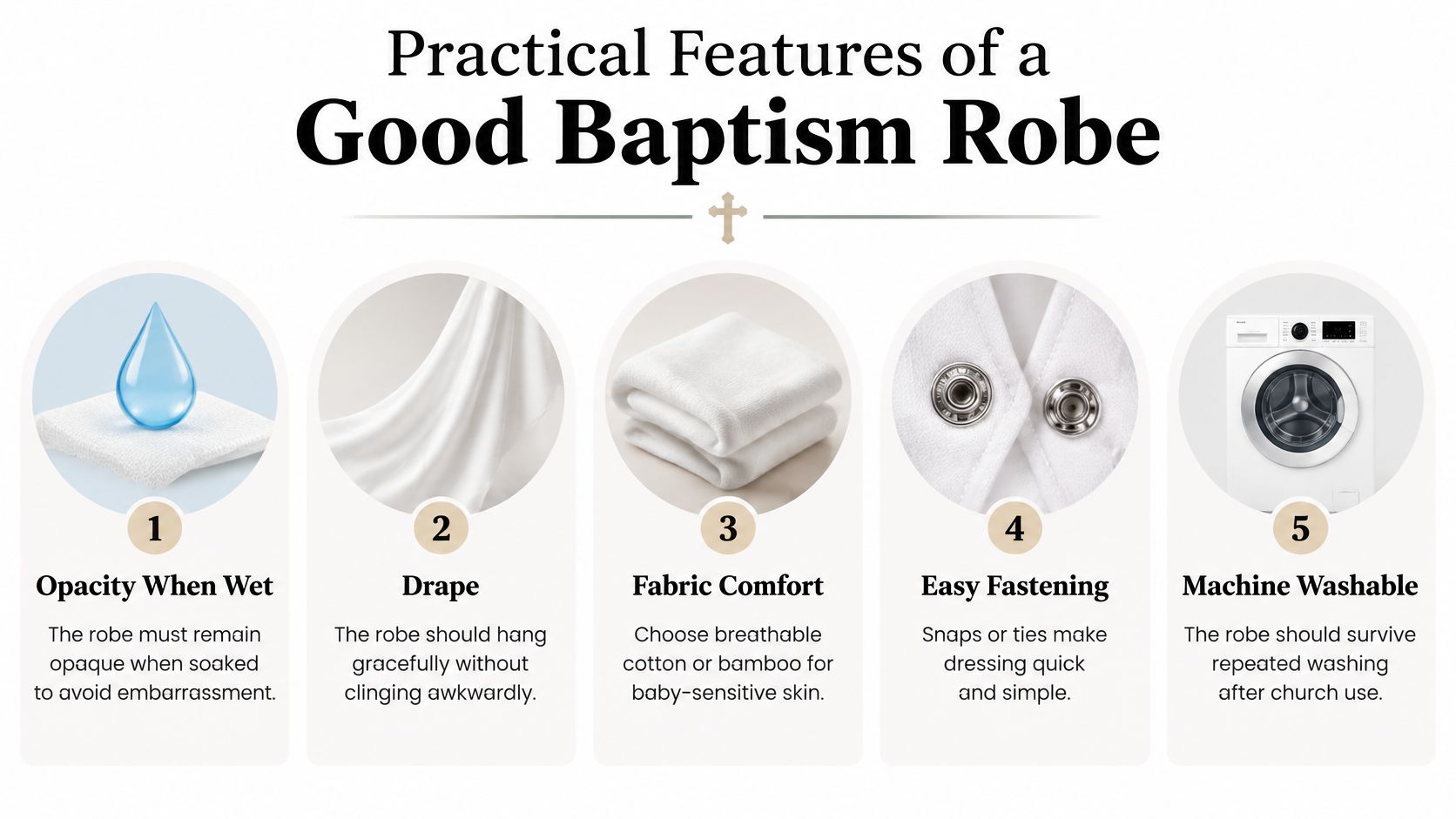
White fabric turns transparent, clings, and reveals underlayers when saturated, which is exactly why practical guidance on what to wear and not wear to a baptism stresses opaque construction over appearance alone. Color is the easy part. Opacity is the part that protects the candidate's dignity.
Features I Insist On
- Wet opacity: Hold the soaked fabric to light before the service, not during it.
- Secure front closure: A James Madison University overview describes the common full-length, long-sleeved white robe that closes with a front zipper in its description of baptismal robe construction, and that zipper exists because ties and buttons fail in water.
- Full-length cut with real ease: The robe shouldn't ride up, bind at the shoulders, or turn into a sail on the steps.
- Quick-drying, seam-strong fabric: Heavy, slow-drying material sags, drags, and makes walking after immersion awkward.
Wet test rule: If you wouldn't trust the robe soaked, under bright lights, in front of the whole congregation, don't buy it dry.
Layer dark or skin-toned modesty clothing underneath where your church allows it, and skip delicate embellishment that adds water weight. Then run the pre-check. Does the church supply the robe? Does it go over swimwear? Is this full immersion, pouring, or sprinkling? Pouring and sprinkling forgive almost any modest white outfit, but immersion doesn't forgive anything, which is why the overview of baptism robes for adults is worth reading before an immersion service.
Choosing Between Single, Bulk, and Custom Robes
Match the purchase to the volume. That's the entire strategy, and churches overcomplicate it every spring.
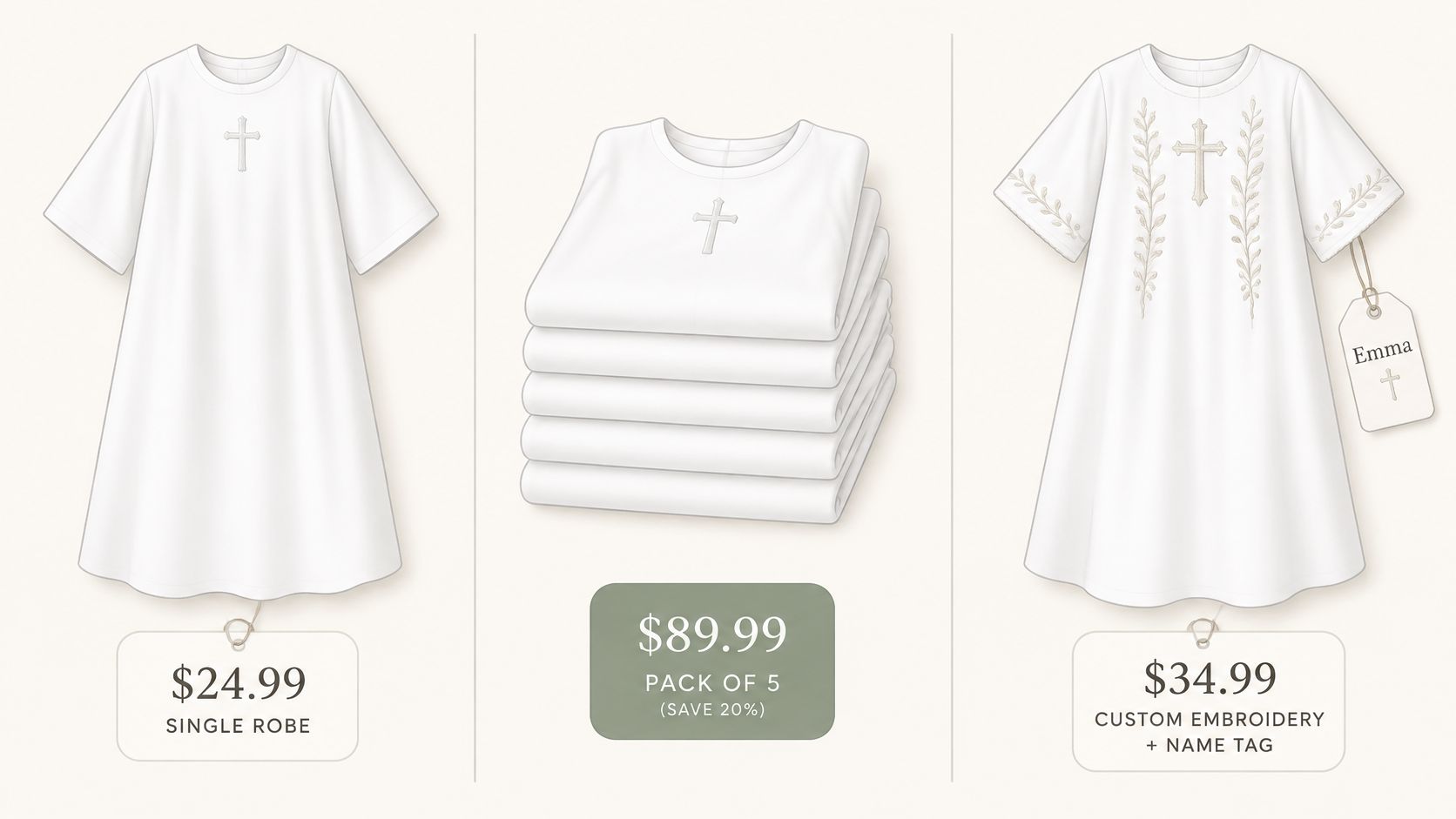
A single robe suits a one-off adult candidate or first-time parents who want a keepsake garment. Buy for height and body measurements, not the nominal size label, and leave time for an exchange.
Bulk ordering suits churches baptizing several people a year. You need inclusive sizing across adults and children, consistent color across the set, and spares in the middle sizes that everyone requests. Standardize on one proven style so washing, storage, and replacement stay simple.
Custom embroidered robes make sense when a congregation wants its name or emblem on the garment, or when a family wants a date stitched into a robe that becomes an heirloom. Embroidery adds lead time, so order earlier than feels necessary.
Rental is the fallback for tight budgets, and it's legitimate. Just confirm who launders the robes, what condition they must come back in, and whether a damaged zipper becomes your problem. Suppliers such as Baptism Robes sell adult, youth, and clergy robes in white and other colors with height-based sizing, which gives churches one reference point when comparing single, bulk, and embroidered options side by side.
Common Misconceptions About White at Baptism
Four myths cause most of the bad decisions I correct. Let's retire them.
White belongs to weddings. No. The Catholic Encyclopedia records that newly baptized people in the primitive Church wore a white robe for a period after baptism, with solemn baptisms commonly held on the eves of Easter or Pentecost, in the encyclopedia's historical entry on baptismal practice. Baptism claimed white long before bridal fashion did.
Guests can never wear white. Wrong as stated. Modest white that doesn't compete with the candidate breaks no rule. If you want a sense of how all-white dressing reads at celebratory events generally, Cedar & Lily white party styling shows the difference between intentional white and accidental costume, and a baptism asks for the quieter end of that range.
The candidate always changes into white afterward. Sometimes. Some congregations dress the candidate before immersion, some hand over a symbolic garment after, and some present infants already in white. Timing follows the church's liturgical order, not a universal script.
White baptism clothing is only for babies. Adults wear the same symbolic color in an adult baptism gown every week. The garment just gets built for immersion instead of for being carried.
A Simple Checklist Before the Day
Run this list in order and you'll walk in calm.
- Confirm the church's plan: Ask whether it supplies baptism robes, what goes underneath, and when the garment goes on. The preparation steps in the guide on how to prepare for baptism pair well with that conversation.
- Decide white by role: Candidate yes, godparent tastefully, guest as an accent, clergy by vestment.
- Match fabric to water: Immersion demands opaque, quick-dry construction and a modesty layer. Pouring and sprinkling don't.
- Order early: Leave room for shipping, size exchanges, and a wet test at home.
- Pack the unglamorous items: Towel, dry underclothes, a bag for the wet robe, and shoes you can walk in on a wet floor.
Frequently Asked Questions
What does the white baptism robe symbolize? New life in Christ. It signifies that the baptized person has put on Christ and risen with him.
Do adults need special garments for baptism? Only if the church requires one. Many supply a robe, so confirm before buying religious attire for adults yourself.
What size baptism robe should I buy? Size by height and actual body measurements. Nominal labels vary too much to trust.
Can baptism robes be reused? Yes, if the fabric, seams, and closure hold up to repeated washing. Churches reuse them routinely.
Where can churches purchase baptism robes in bulk? From church supply retailers offering matched sets across adult, youth, and clergy sizes with consistent stock.
If you're outfitting one candidate or a full baptism Sunday, Baptism Robes carries adult, youth and child, and clergy robes in classic white with height-based sizing, quick-dry fabrics, and custom embroidery options. Browse the sizes, run your wet test plan against the product details, and order early enough that an exchange is a minor errand instead of a baptism morning emergency.