

You're ordering baptism clothing, and the size list looks straightforward until someone asks whether a broad-shouldered adult needs XL or whether a growing child should move into an adult robe. Height gets you started, but it doesn't settle every fit question. A robe that's roomy through the chest can still be too long at the feet.
A useful robe sizing chart treats baptism robes as loose ceremonial wear, not fitted fashion apparel. Start with the wearer's height, then check chest room, underlayers, sleeves, and the intended hem position. That approach supports the Adult Baptism Robes category while helping families and church staff make sensible decisions for younger candidates and clergy.
Adult Baptism Robe Size Chart by Height
Adult robe size bands by height
The following table is an orientation guide, not a verified product-size assignment. Use it to identify the tier to investigate, then confirm the numbered size and its stated body range on the selected garment before ordering. Metric equivalents are rounded.
| Height (imperial) | Height (centimetres) | Size tier to check first | Fit note |
|---|---|---|---|
| 4 ft 6 in to 4 ft 11 in | 137 to 150 cm | Standard tier | Check hem length first |
| 5 ft 0 in to 5 ft 5 in | 152 to 165 cm | Standard, middle sizes | Standard may fit; size up if layering requires more room |
| 5 ft 6 in to 5 ft 11 in | 168 to 180 cm | Standard middle sizes | Choose the larger option if between product bands |
| 6 ft 0 in to 6 ft 3 in | 183 to 191 cm | Standard or tall-frame size | Check sleeve and hem; choose larger if between |
| 6 ft 4 in to 6 ft 8 in | 193 to 203 cm | Upper standard sizes, XL where listed | Check XL for broad frames, not height alone |
These are example lookup bands rather than a substitute for a manufacturer's chart. In particular, standard, tall, and XL aren't interchangeable labels. A tall option may add length, while an XL option may add width, length, or both.
Why height leads the decision
Full-length baptism garments need appropriate vertical coverage. A familiar shirt size doesn't tell you where a robe will finish, and a roomy chest doesn't guarantee adequate sleeve length.
The historical review in the Beltwide Cotton Conferences proceedings traces apparel sizing to body-measurement surveys rather than arbitrary labels. The practical lesson is straightforward: select ceremonial clothing from measurable dimensions, not from an assumption that your usual clothing size transfers.
A sound chart distinguishes body measurements from finished-garment measurements. The ISO garment-size designation framework identifies clothing through primary and secondary body dimensions, expressed as the body ranges the garment is intended to accommodate. Manufacturers determine the garment's actual dimensions according to its cut, intended use, and allowances.
For a baptism robe, height is a practical first dimension. Chest, bust, or hip circumference provides the next check, depending on where the wearer needs the most room.
Read body ranges and garment dimensions differently
Consider a hypothetical chart with a height range of 160 to 170 cm and a chest range of 85 to 105 cm. A wearer measuring 170 cm tall with a 96 cm chest falls within those example body ranges. Those figures illustrate how to read a chart; they aren't a confirmed Baptism Robes size assignment.
If that robe's finished chest circumference is considerably larger than the wearer's chest, it isn't automatically too big. The difference is ease, the extra space built into the garment for underclothes, movement, and coverage.
Watch the measurement description carefully:
- Body chest means the circumference measured around the wearer.
- Flat chest width means the garment measured across while lying flat, not all the way around.
- Finished chest circumference describes the garment itself, including its built-in room.
- Garment length needs a stated starting point, such as the shoulder, to be useful.
Never compare a flat width directly with a body circumference. Ask what the measurement represents before deciding that the chart must be wrong.
Practical rule: A loose robe should allow movement without pulling across the chest, but extra width doesn't excuse an unsafe hem.
Adult height-based fitting works for men and women, with body proportions checked individually. The same approach applies to Clergy and Pastor Baptism Robes, although a pastor's intended underlayers and working movements deserve particular attention.
Fabric also affects how roomy clothing feels. California Cowboy's guide lets you compare men's robe fabrics and fits, which is useful background when distinguishing fabric weight from garment dimensions. Don't transfer a leisure-robe size directly to an immersion garment.
Find the height band first, read across to the tier, and verify the selected product's body range. If the wearer sits between bands or needs unusually generous chest room, take the complete measurements before choosing.
Youth and Children's Baptism Robe Size Chart
Youth and children's robe bands by age and height
Age labels help organize an order, but they don't establish fit. This table uses measurement-based rules where a verified age or height interval isn't available.
| Group | Typical age or selection rule | Height check | Sizing note |
|---|---|---|---|
| Infant | Baby requiring an infant gown | Use the infant product's measurements | Use the infant baptism gown band, not youth |
| Toddler | Toddler-stage wearer | Match measured height to the child garment | Allow hem room; check fit at the shoulder |
| Child | Younger child | Use the child chart's stated height range | Choose the larger band if between heights |
| Older child | Child approaching youth sizing | Compare current height with child and youth ranges | Measure barefoot in intended underclothes |
| Youth | Teenager or wearer using youth sizing | Check youth height and chest limits | Taller teens may fit the adult standard tier; check chest |
When age and height disagree
Children's baptism apparel should follow the child's measurements, not a birthday label. A tall younger child may need the next height band, while an older child with a smaller frame may still fit a child robe. Neither case justifies skipping the chest and shoulder checks.
Infant gowns need separate treatment. Their proportions, dressing needs, and intended presentation differ from youth robes, so don't select an infant garment by borrowing a youth height band.
Growth matters when ordering well before the service. For toddlers and young children, leave usable room without buying a robe that already drags. A shoulder seam that slips down the arm or a sleeve that hides the hand signals that the larger garment needs closer review.
- For children between bands: Try the larger band and confirm that the hem finishes around the ankle line.
- For tall teens: Compare adult and youth body ranges rather than assuming adult sizing is automatically wider enough.
- For delayed services: Recheck the child's measurements before any exchange window closes.
The Youth and Child Baptism Robes category is the appropriate starting point for younger candidates. Our guide to children's baptism clothing can help families plan the rest of the outfit without using extra robe length as a substitute for proper coverage.
How to Measure a Wearer for a Baptism Robe
Measure the wearer, not an existing robe, and measure over the clothes they'll wear underneath. Use a flexible dressmaking tape, a rigid book, a wall, and a shared measurement form. Keep bulky outerwear out of the measurement unless it will remain under the robe.
Use this visual guide alongside the written measurements.
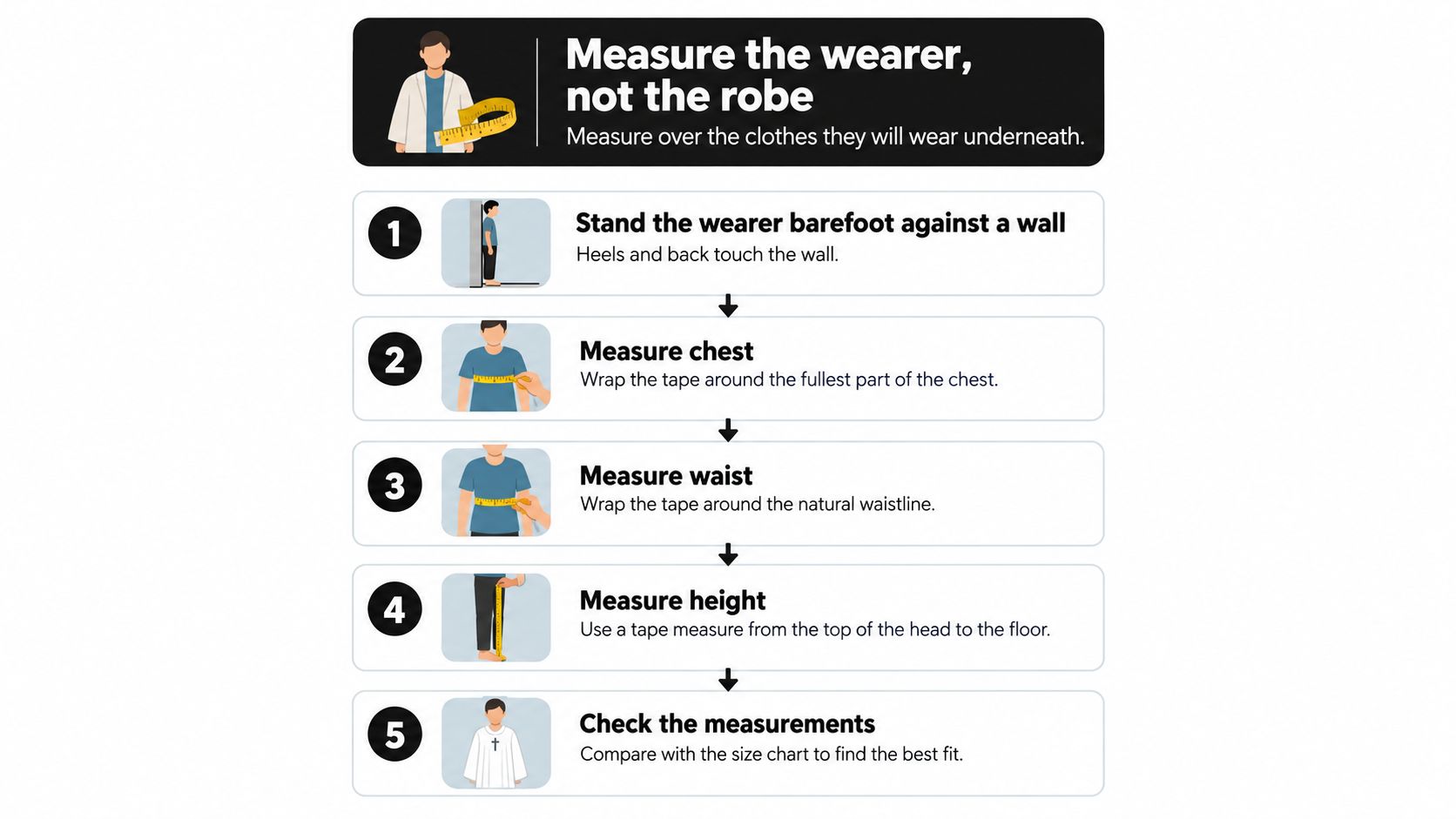
- Position the wearer. Have them stand barefoot against a wall, feet together, with heels and back against it where comfortable. Keep the head level rather than tilted upward.
- Record total height. Rest a book level on the head, mark the wall, and measure from the floor to the mark. Record the unit beside the result.
- Measure chest or bust. Pass the tape beneath the arms around the fullest point, keeping it horizontal and firm without compressing the clothing.
- Check sleeve needs. With the arm slightly bent, measure from the shoulder point to the wrist. Note the starting point because sleeve-measurement methods can differ.
- Set the desired hem. Measure from the shoulder to the intended finish, usually near the ankle for a full gown. Keep the tape following the intended garment line rather than pulling it diagonally.
- Check the broadest area. Repeat an uncertain chest reading and measure the hips if they need more room than the chest. Don't assume chest alone represents every body shape.
- Save the measurements together. Record the wearer's name, height, chest, hip where relevant, sleeve, desired length, and intended underlayers on the same form.
The most common avoidable errors are slouching, measuring over a thick coat, tightening the tape, and reading the wrong unit scale. Have the wearer breathe normally and check that the tape hasn't slipped upward at the back.
Separate size selection from alteration guidance
The ISO clothing-size measurement guide supports erect, barefoot height measurement and level, non-constricting circumference measurements. It also distinguishes measurement systems for different wearer groups rather than treating children as scaled-down adults.
Height and the listed body circumference select the size band. Shoulder-to-hem and shoulder-to-wrist measurements help check the garment's actual coverage; they don't override its chest limits.
If you're unfamiliar with measurement diagrams, you can compare cashmere apparel sizes through Cashmere Boutique's guide to see how apparel measurements are presented. Use that only for measurement literacy, not as a baptism robe sizing chart.
Keep the written form beside you when reviewing this measurement video.
Converting Inches and Centimetres for Your Measurements
To convert inches to centimetres, multiply by 2.54. To convert centimetres to inches, divide by the same conversion factor. Treat these as unit calculations, not additional sizing allowances.
For example, a hypothetical wearer at 5 ft 8 in measures 68 inches, or 172.7 cm after rounding. That places the wearer in the illustrative 168 to 180 cm lookup band, subject to the selected product's actual chart.
Inches to centimetres for common robe measurements
| Inches | Feet and inches | Centimetres, calculated |
|---|---|---|
| 40 in | 3 ft 4 in | 101.6 cm |
| 48 in | 4 ft 0 in | 121.9 cm |
| 54 in | 4 ft 6 in | 137.2 cm |
| 60 in | 5 ft 0 in | 152.4 cm |
| 66 in | 5 ft 6 in | 167.6 cm |
| 72 in | 6 ft 0 in | 182.9 cm |
| 78 in | 6 ft 6 in | 198.1 cm |
| 80 in | 6 ft 8 in | 203.2 cm |
If the order form accepts only whole centimetres, round a fractional measurement upward rather than understating it. Retain the original reading so a rounded value doesn't conceal a boundary question.
For international orders, label every field clearly. Use one primary unit throughout the form, with the conversion in a separate field, rather than mixing unlabelled inches and centimetres. Convert height first, match the chart, and save both readings with the order.
Choosing Standard or XL Between Sizes and Layers
When the wearer is between bands or needs substantial underlayers, start with the larger option, then check the hem. This is a fit decision, not permission to buy excess length. Standard and XL must be compared using the dimensions of the particular robe.
A FashionUnited report on apparel sizing identifies size and fit as a major return issue, reinforcing the value of checking more than a label before ordering.
Which size to choose in borderline cases
| Situation | Choose | Why |
|---|---|---|
| Height falls exactly on a band boundary | Larger size, subject to hem check | The wearer needs unrestricted movement and coverage |
| Height in band but chest above the listed range | XL size with a sufficient stated chest range | Appropriate width prevents strain and gaping |
| Heavy layers under the robe | Larger size after measuring over those layers | Added clothing needs space at the chest and sleeves |
| Tall wearer with narrow shoulders | Standard size with adequate length; check hem | The problem is length rather than girth |
| Measurements conflict by more than one band | Contact our team before ordering | Individual sizing guidance is safer than guessing |
When more room helps and when it doesn't
A robe that pulls across the upper back when the wearer reaches forward needs more usable room. So does one that strains over the hips when sitting. Check these movements during a dry fitting with the intended underclothes.
By contrast, a narrow-framed tall wearer may gain nothing from a much wider robe. Check garment length and sleeve length before choosing XL solely because the wearer is tall.
For children whose height and body size fall in different ranges, prioritize a garment that accommodates the body without creating an unmanageable hem. The same judgement applies to Pastor baptism vestments worn over other religious attire.
More fabric is helpful only when the wearer can move without stepping on it.
Avoid a hem that catches beneath the feet on steps or pools around the ankles. Don't depend on holding the robe up throughout the service.
Our guide to baptism robes for adults offers additional context for choosing an Adult baptism gown. If chest and height point far apart, our team can guide you through sizing before you commit to an order.
Ordering Sizes for Mixed Groups and Bulk Church Orders
Church staff need more than a list of names and usual shirt sizes. Mixed groups may include adults with different proportions, children who are still growing, and pastors wearing additional garments. Collecting consistent information is more useful than ordering a broad assortment and hoping everyone finds something.
The Sunbve discussion of online clothing returns and sizing describes shoppers ordering multiple sizes to manage uncertainty. For a church, a targeted reserve is a more controlled approach than duplicating the entire order.
Build an order list that someone else can check
- Collect the same fields from everyone. Request height, chest, intended underlayers, and any concern about sleeves, hips, or mobility. Include the measurement date so older readings are easy to identify.
- Sort candidates into infant, child, youth, adult, and clergy groups. Keep each group attached to its own product chart so similar-looking size names don't get mixed.
- Assign a proposed size and a review status. Mark uncertain fits for follow-up instead of treating them as confirmed.
- Have another coordinator compare each proposed size with the relevant body range. Resolve missing units, duplicate names, and unexplained size changes before submission.
- Arrange a dry fitting before the service. Leave time to address problems under the applicable return terms rather than discovering them at the baptismal pool.
Keep personal measurements within the group responsible for fitting. A public volunteer list needs names and assignments, not everyone's chest measurements.
Reserve adjacent sizes, not duplicate wardrobes
Choose reserve garments around actual uncertainty. If several candidates sit near the same boundary, adjacent sizes there are more useful than unrelated extras.
Label reserve robes by their actual size and keep them separate from assigned garments. For children and youth, recheck measurements close enough to the service to catch growth while there's still time to act.
- Budget: Separate confirmed garments from optional reserves.
- Timing: Identify the fitting date before finalizing the order.
- Returns: Check whether trying on, washing, customization, or immersion affects eligibility.
- Administration: Keep the final sorted list with the order confirmation.
Our team guides customers through sizing and assists with large church orders. We may limit quantities purchased per person, per household, or per order, so discuss unusual requirements before relying on an assumed quantity.
Use our Bulk Ordering Baptism Robes guide for procurement planning. Keep deacon and pastor requirements grouped under Clergy and Pastor Baptism Robes, with underlayers and sleeve needs recorded separately from candidate attire.
Custom Sizes, Returns and Wrong Measurements
Custom robes aren't refundable or exchangeable when the customer supplied the wrong measurements. We make custom baptism robes to order according to the specifications we receive, so the submitted measurements are production instructions, not approximate preferences.
An incorrect height can affect the entire garment. A correct height paired with the wrong chest measurement can still produce an unsuitable fit, and embroidery won't solve either problem.
Check before submitting specifications
- Confirm the wearer: Match the name on the measurement form with the name on the order.
- Check the units: Make sure height, chest, and desired garment length haven't been entered in different scales.
- Confirm the hem: Record the intended finish clearly instead of using “full length” without context.
- Review the fit choice: Resolve standard versus XL before approving personalization.
- Proof the embroidery: Check the church name, personal name, capitalization, and placement only after the size is settled.
If you notice an error, contact our team immediately. An early correction offers the best chance of avoiding unnecessary work, but don't assume a submitted custom order can always be changed before production.
Before approval: Read the measurements from the original form, not from memory or a previous garment's label.
We may change or cancel an order, including after submission, if the order information is inaccurate. That makes accurate contact details and a clear specification important for adult, youth, and pastor orders alike.
Standard, non-custom garments follow the applicable returns terms. Read those terms before ordering, particularly if you plan to buy alternative sizes for a fitting.
For custom embroidered options within Adult Baptism Robes, settle the garment dimensions before approving decorative details. Keep a copy of the final specifications so everyone involved is working from the same version.
Frequently Asked Robe Sizing Questions
Fit and care questions
Will a baptism robe shrink?
There's no single shrinkage allowance to apply across different fabrics and constructions. Follow the care label, avoid hot washing unless permitted, and don't buy a smaller robe expecting shrinkage to improve the fit. Use the measurement method to select for the wearer's current body.
How do I choose sleeve length and overall length?
Use shoulder-to-wrist and shoulder-to-hem measurements as separate checks. An ankle-length finish is practical for a moving wearer; don't choose floor-draping length without considering the service setting. The measuring instructions explain where each reading starts.
Does embroidery change the size I should order?
Embroidery doesn't create a different body-size band, so confirm fit before approving personalization. Position a large name or crest away from edges where it could interfere with the intended finish. Follow the custom-order checks before submitting specifications.
Children and ceremony questions
Can I use the youth chart for an infant gown?
No. Infant gowns need their own product measurements rather than a reduced youth size. Use the children's sizing guide to distinguish infant, child, and youth selection.
Do adults need a special garment for baptism?
Not every Christian community requires a special robe. The Archdiocese of Newark's baptismal garment guidance explains that the Roman Catholic rite treats the garment as optional and permits white or another color according to local custom, while alb-style garments are common in U.S. dioceses. Confirm your church's baptism ceremony traditions first, then use the adult sizing guidance to choose appropriate coverage.
Confirm Your Size Before You Order
Make the final decision from the measurement form, not from how the robe looks in a photograph. Whether you're considering baptism outfit ideas for a family member or religious attire for adults in a church group, keep category, fit, and garment version separate.
Use this visual reminder when checking the order.
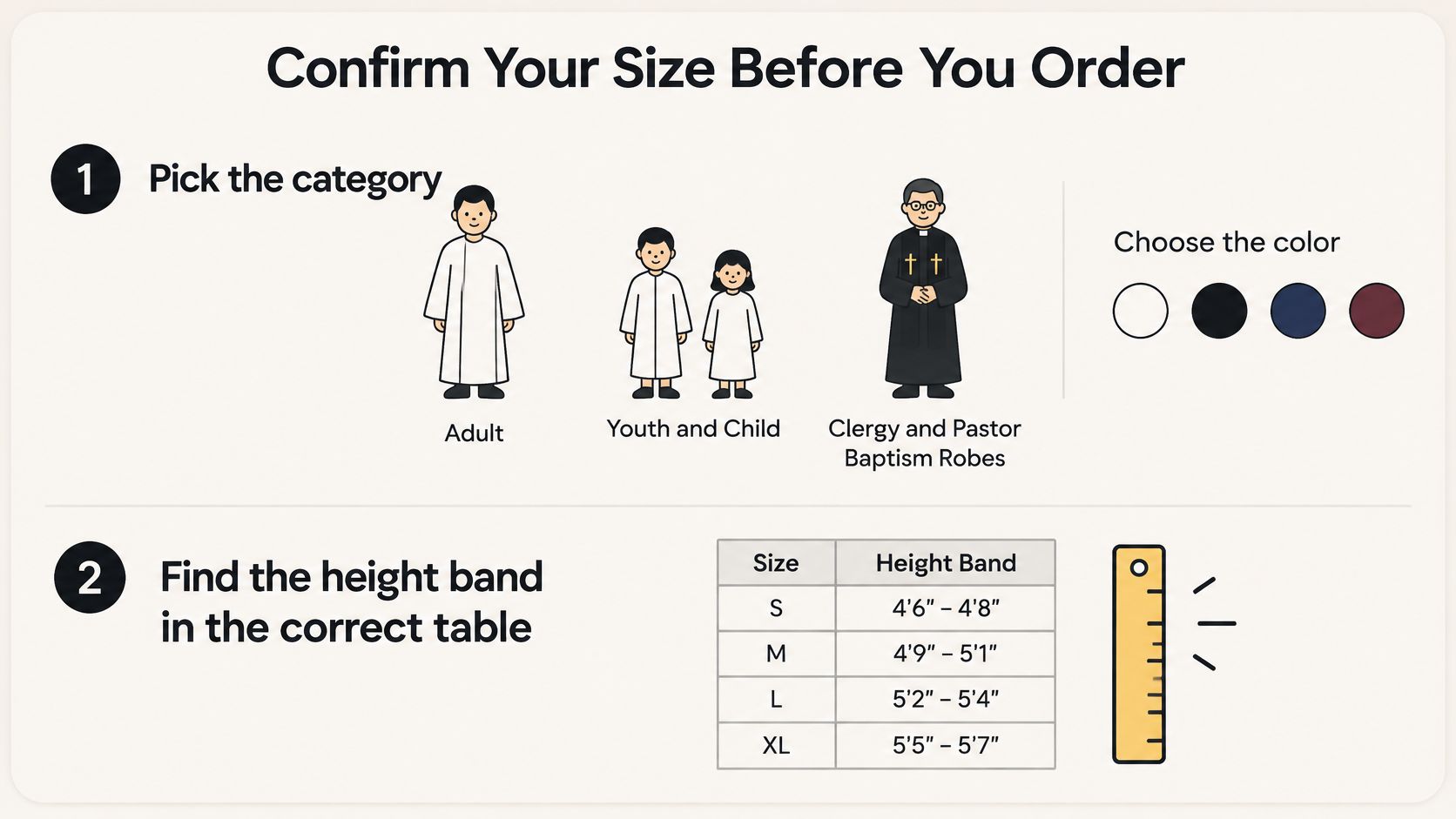
- Choose the category and color. Select Adult, Youth and Child, or Clergy and Pastor Baptism Robes according to the wearer and service.
- Match the measured height to the selected garment's chart, then confirm chest, sleeve, and hem requirements.
- Choose the appropriate version. Our Premium White Baptismal Pastor Robe comes in sizes 39 to 63XL, matched to height ranges from 4 feet 6 inches to 6 feet 8 inches. White religious robe versions have a loose fit and may feature long sleeves or gown-length draping, so check the specific version against the recorded coverage needs.
- For church orders, send the sorted group list to our team for sizing help. We offer bulk discounts on baptism robes.
- Keep the records together. Save the measuring form, approved custom specifications where applicable, and order confirmation.
Church coordinators can use the Bulk Ordering Baptism Robes article for purchasing preparation. Families should also plan care and storage after the service, using the garment's care label as the authority for washing and drying.
Baptism Robes offers baptismal attire for adults, children, youth, and clergy, with sizing guidance and assistance for large church orders. Visit Baptism Robes with your wearer measurements or sorted group list to choose suitable garments and resolve uncertain fits before ordering.