

A pastor is standing beside the baptistry with a candidate in a robe that reaches the floor. The sleeves stop above the wrists, the chest pulls when the candidate raises both arms, and a volunteer is searching for safety pins while the congregation waits. In the children's line, another robe drags under a child's feet because someone chose by age instead of height.
These problems don't come from a lack of care. They come from treating baptism clothing like ordinary apparel and trusting an unexplained S, M, L, or XL label. A baptism robe needs enough coverage for modesty, enough room for movement and layering, and a controlled length for walking, stepping, and immersion.
This robe size chart guide is built for church administrators, pastors, ministry leaders, adult candidates, and families. It covers Adult Baptism Robes, youth and children's baptism apparel, and Clergy and Pastor Baptism Robes, with practical rules for measuring, choosing between standard and XL cuts, ordering in bulk, and handling unusual fits.
Why a Baptism Robe Size Chart Matters Before Service Day
A baptism service exposes poor sizing quickly. A robe that looks acceptable on a hanger can become restrictive when a candidate raises their arms for prayer, steps into the water, sits on a changing bench, or turns toward the congregation. Wet fabric can also behave differently from dry fabric, making excess length, inadequate coverage, or a tight chest more serious than they first appeared.
The right starting point is a body-based chart that identifies height, chest or bust, waist or hip circumference, and intended length. Those measurements help a supplier choose a practical garment while leaving room for modesty and movement. A finished robe still needs its own internal specifications, but customers should compare their bodies with the wearer-size chart, not compare themselves with a robe laid flat.
Practical rule: If the chart doesn't tell you whether its numbers describe the wearer or the finished garment, don't order a group shipment until the supplier confirms it.
Here are the most common failures I see during church measurement days:
| Fit Problem | Likely Cause |
|---|---|
| Hem drags near the font or floor | Height was estimated, or the robe was chosen by age |
| Sleeves stop above the wrists | Chest or height band was treated as optional |
| Robe pulls across the torso | Standard cut was selected despite a larger chest or layered clothing |
| Child trips while walking | Adult sizing was scaled down without checking finished length |
| Garment becomes revealing when wet | Close fit and fabric behavior were ignored |
| Group receives the wrong mix of sizes | Administrators ordered familiar letter labels instead of recording measurements |
A clear chart prevents last-minute exchanges and helps a church outfit a full class consistently. It also gives adult candidates a dignified way to choose religious attire for adults without guessing what “large” means from one supplier to another.
How Height-Based Sizing Replaced Age-Based Labels
Height should be the primary key for a full-length baptism robe. Age is a weak proxy because children of the same age can have very different body dimensions. A child's chest, waist, shoulder width, and growth pattern may not match another child's, even when their birthdays are close.
The history of apparel sizing supports measurement-led charts. In the United States, the first major clothing-sizing survey was reported in 1921 and measured approximately 100,000 men during military demobilization after World War I. A national survey conducted from 1937 to 1941 measured about 147,000 boys and girls, creating a substantial early dataset for children's apparel sizing. Measurements collected during 1939 and 1940 also contributed to the National Bureau of Standards' 1958 Commercial Standard 215-58 for women's patterns and apparel, as documented in this historical overview of apparel sizing.
Those milestones matter because practical robe charts follow the same basic logic. Start with a vertical measurement, add a girth measurement, and allow ease for the activity. Height controls coverage and manageability. Chest, bust, waist, or hip measurements help resolve differences within the same height band.
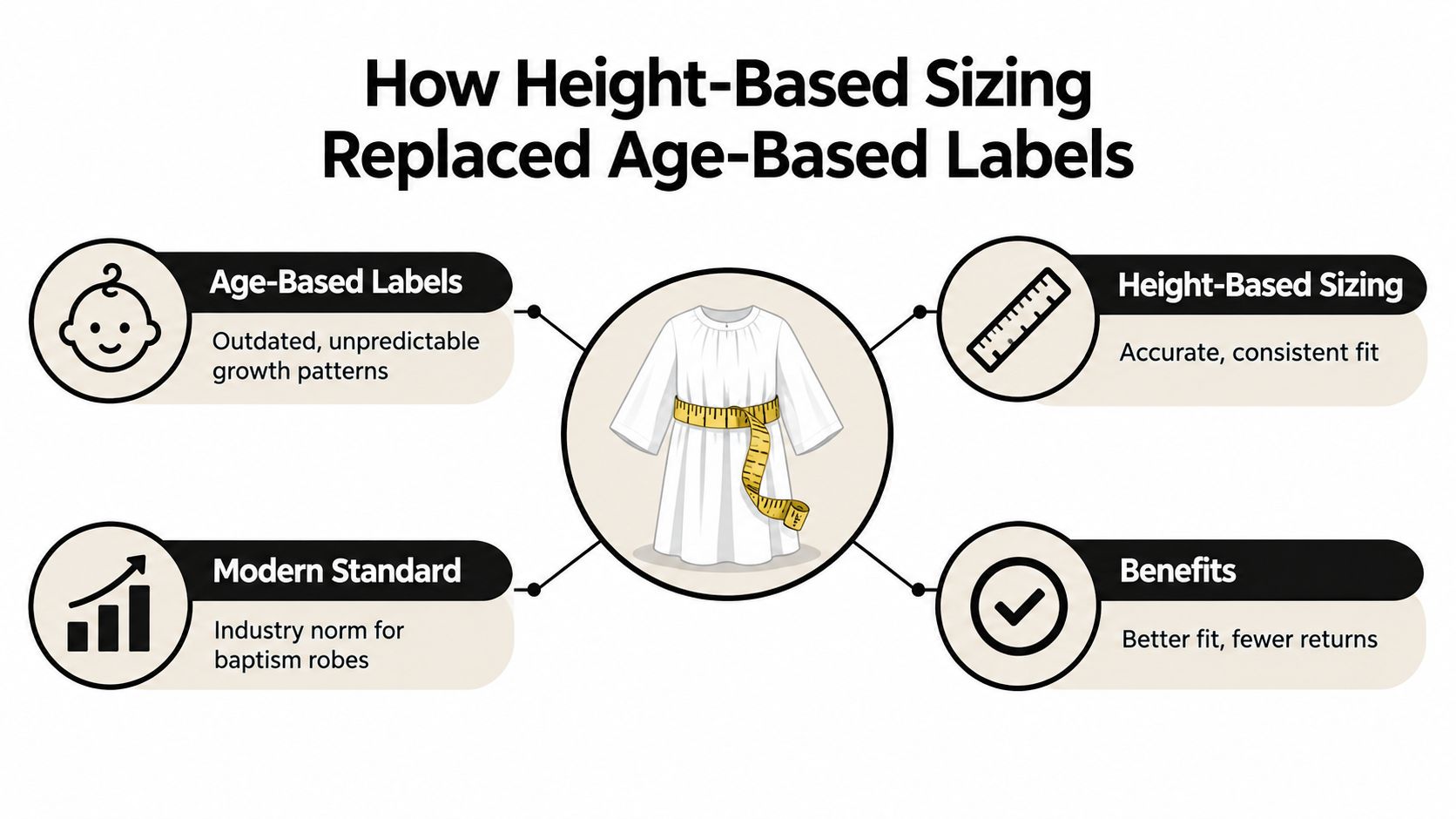
The labels are not universal
Letter labels create false confidence. The United States has no mandatory national clothing-size labeling standard, and the National Bureau of Standards' women's sizing system introduced in 1958 was withdrawn by the U.S. Department of Commerce in 1983, according to this summary of U.S. clothing-size standards. Manufacturers later departed substantially from older standards, contributing to inconsistent numerical labels and vanity sizing.
For baptism apparel, that means an adult medium from one supplier may not match an adult medium from another. A numeric height range with clearly defined chest and waist checkpoints is more useful for a mixed church group than a familiar but unexplained label.
ISO 8559-2 also distinguishes body measurements from garment measurements. Body measurements identify the intended wearer. Garment measurements are developed separately to account for cut, styling, wearing position, and movement allowance, as explained in the ISO standard for clothing size designation.
Measuring the Wearer in Four Simple Steps
Measure the person, not a robe on a table. Have the candidate wear light clothing, stand naturally, and keep the tape level without pulling it tight. The goal is a repeatable body record that another volunteer can use when assigning a size.
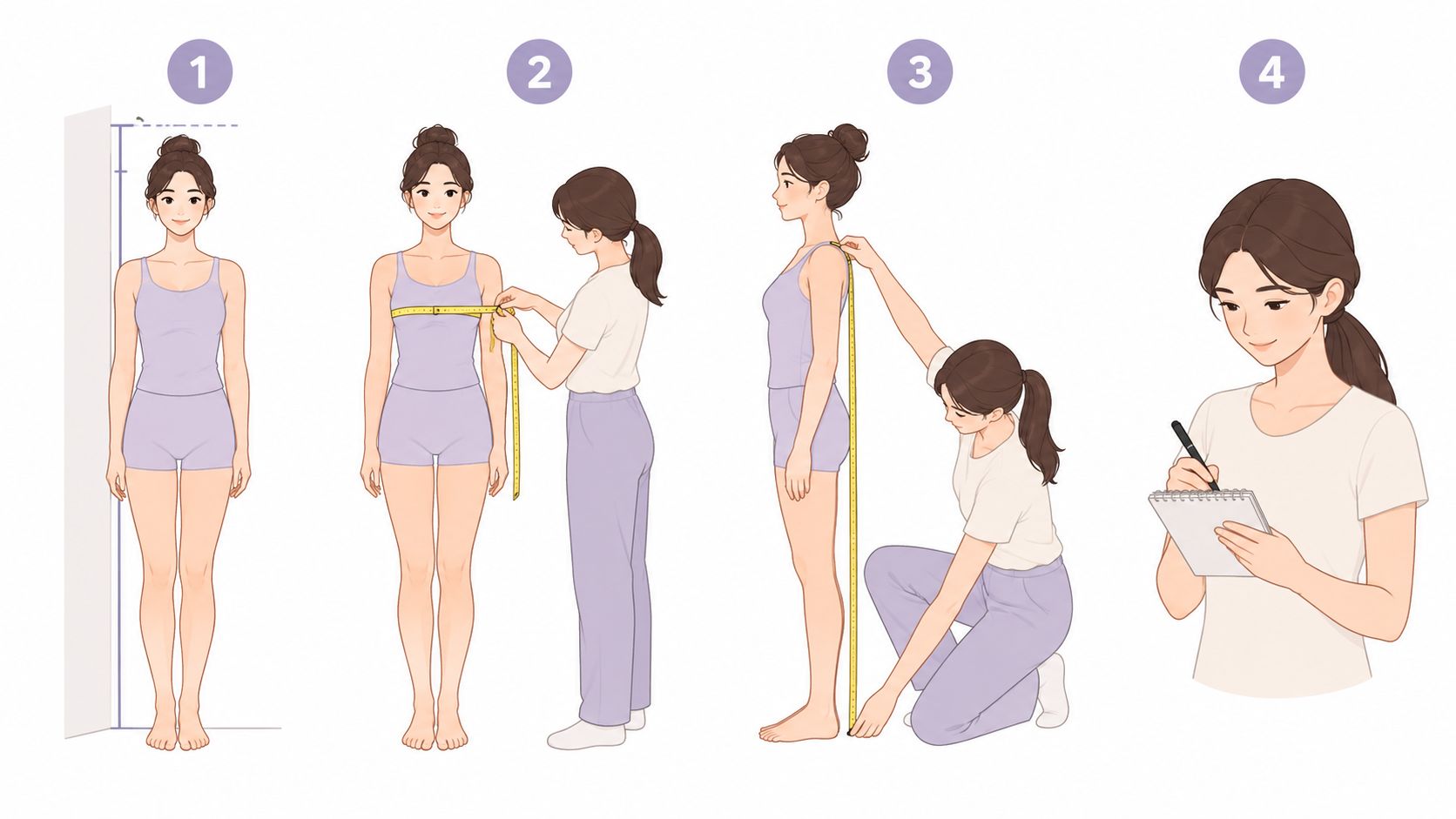
Follow this sequence
- Height: Remove shoes and stand against a flat wall with the head level. Mark the highest point of the head, then measure from the floor to that mark. Don't round a borderline height into a shorter band.
- Chest or bust: Place the tape around the fullest part of the chest or bust. Keep the tape horizontal and relaxed. It shouldn't compress the body, but it shouldn't sag across the back either.
- Waist: Find the natural waist, usually the narrower area between the ribs and hips. Measure over a single light layer rather than a coat, sweater, or bulky dress.
- Desired finished length: Measure from the robe's intended shoulder or neck reference point toward the planned hem. Don't measure from the floor, because floor-based measurements produce inconsistent results when shoes, posture, or reference points change.
The essential guide for dressmakers offers useful general measurement technique, but baptism robes require an extra check for mobility and wet coverage. Record the numbers before anyone tries on a sample.
| Measurement | How To | Wearer 1 | Wearer 2 |
|---|---|---|---|
| Height | Barefoot, standing naturally against a wall | ||
| Chest or bust | Fullest point, tape level and relaxed | ||
| Waist | Natural waist, without pulling tight | ||
| Desired length | Shoulder or neck reference to planned hem |
Have candidates raise both arms and take a few steps after measuring. This catches sleeve and length problems that a standing measurement can miss.
Give families a copy of the worksheet before the appointment. A simple record with name, height, chest, waist, assigned cut, and notes is enough to eliminate most guesswork during a group order.
Standard vs XL Cuts and the Between-Sizes Rule
Standard and XL aren't merely fashion labels. They describe different amounts of usable room through the chest, waist, shoulders, and sometimes the length. A standard cut generally suits a narrower or average frame within the assigned height band. An XL cut gives more room for broader frames, fuller figures, and clothing worn underneath.
Choose by height first, then use chest or waist as the tie-breaker. If a candidate falls between height bands, choose the larger height band when the extra length can be managed safely. If the chest or hip measurement exceeds the standard range for that height, select XL rather than forcing the body into a standard cut.
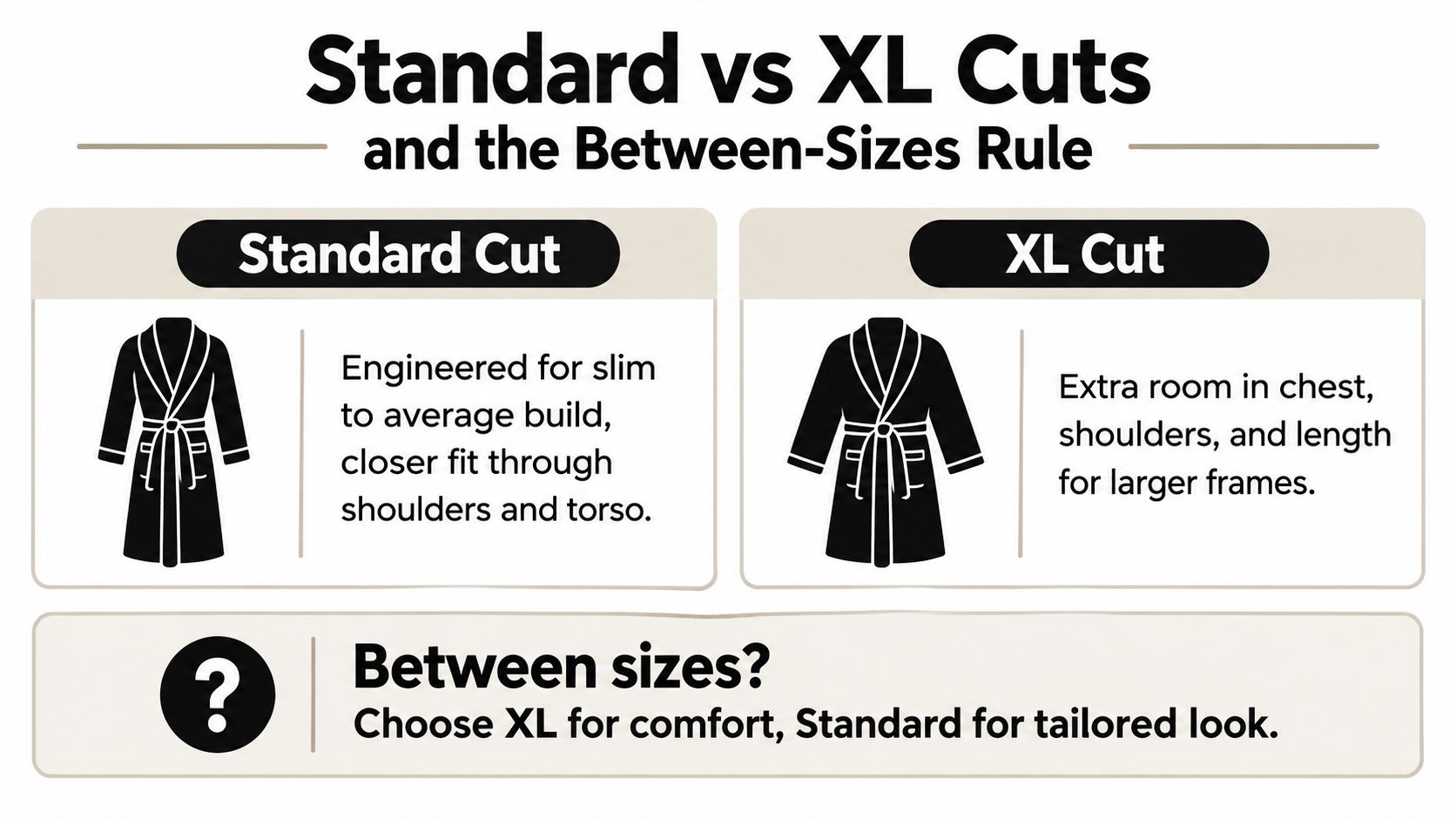
Use this decision matrix
| Candidate Profile | Recommended Cut | Reason |
|---|---|---|
| Height and chest both sit comfortably inside the standard range | Standard | Provides practical room without unnecessary volume |
| Height falls between two listed bands | Larger height band | Protects coverage and sleeve length |
| Chest, bust, waist, or hip exceeds the standard interval | XL | Prevents pulling across the torso |
| Suit, modest dress, or layered clothing will be worn underneath | XL when measurements are borderline | Adds useful layering room |
| Candidate is tall but narrow | Taller standard size | Preserves sleeve and hem coverage without excess width |
| Candidate is broad and tall | Taller XL size | Addresses both vertical coverage and girth |
The between-sizes rule is simple: choose the larger relevant size, and choose XL when girth is the measurement that exceeds the standard range. Don't let a familiar letter label override the actual body record.
Call customer support before a bulk order when several candidates fall near a boundary, when a visiting pastor isn't available for measurement, or when a robe will carry embroidery. A supplier should be able to explain whether the chart lists body measurements, finished measurements, or both.
Children and Youth Robe Size Chart
Children need their own sizing logic. ISO 8559-3 supports developing ready-to-wear systems around measurement intervals for population groups rather than scaling adult sizes down. ASTM body-measurement guidance also treats body data as a baseline that must be interpreted alongside fabric, ease, styling, and intended fit, as reflected in this ASTM body-measurement standard.
Use height as the first filter, then check the child's chest or waist. A robe that is slightly generous through the body can work well, but excessive length creates a walking hazard at the font. For a growth spurt, choose a larger size only when the hem can be controlled safely. A quick hem is preferable to allowing fabric to collect under the child's feet.
The values below are a working worksheet format, not a substitute for the supplier's current chart. Enter the supplier's published ranges and finished lengths before placing a class order.
| Height (in) | Height (cm) | Standard | XL | Finished Length |
|---|---|---|---|---|
| 36 to 40 | 91 to 102 | Match child's height and chest range | Use when chest or waist exceeds standard | Confirm shoulder-to-hem measurement |
| 40 to 44 | 102 to 112 | Choose when body measurements fit standard | Choose for fuller build or layering | Confirm ankle clearance |
| 44 to 48 | 112 to 122 | Choose by height first | Choose when girth needs additional room | Check walking and stepping |
| 48 to 52 | 122 to 132 | Standard youth range when chest fits | XL youth range when chest exceeds standard | Avoid floor contact |
| 52 to 56 | 132 to 142 | Standard youth range | XL youth range or larger cut for broader frames | Check raised-arm sleeve coverage |
| 56 to 60 | 142 to 152 | Older youth or smaller adult range | XL when layering or girth requires it | Confirm hem position |
| 60 to 64 | 152 to 163 | Youth or adult range based on supplier chart | XL for broader candidates | Test movement before service |
The correct children's baptism clothing guide should sit beside the worksheet during measurement day. Record each child individually. Don't assign every child in a class the same size because they attend the same age group.
Adult Baptism Robe Size Chart and Finished Length
Adult baptism gown selection starts with vertical coverage, then moves to chest, bust, waist, and clothing underneath. This approach works for first-time adult converts, adults being rebaptized, and candidates who need a modest outer layer over a suit, trousers, or a dress.
A chart should identify both the body range and the finished garment length. The size values below provide a practical format for communicating with a supplier, while the actual product chart should control the final assignment.
| Height (in) | Height (cm) | Standard | XL | Finished Length |
|---|---|---|---|---|
| 59 to 61 | 150 to 155 | Standard adult short range when chest fits | XL for broader chest or layering | Mid-calf to ankle, confirm supplier length |
| 61 to 63 | 155 to 160 | Standard adult range | XL for fuller build | Check hem while walking |
| 63 to 65 | 160 to 165 | Standard regular range | XL when chest or waist exceeds standard | Ankle coverage preferred |
| 65 to 67 | 165 to 170 | Standard regular-tall range | XL for broader frames | Check floor clearance |
| 67 to 69 | 170 to 175 | Standard tall range | XL for girth or layered clothing | Confirm sleeve reach |
| 69 to 71 | 175 to 180 | Standard tall range | XL for broader shoulders or torso | Test arm elevation |
| 71 to 73 | 180 to 185 | Standard tall range | XL for broad or layered fit | Avoid excess hem at steps |
| 73 to 75 | 185 to 191 | Tall standard range | Tall XL or custom review | Confirm full movement |
| 75 to 78 | 191 to 198 | Extended tall range | Extended XL or custom review | Ask supplier to verify length |
Three questions come up on nearly every adult fitting.
Will the sleeves cover the wrists when the arms rise? Height is the first signal, but shoulder width and chest room affect sleeve position. Test both arms overhead before approving the robe.
Will the hem stay manageable near the water? A full-length robe shouldn't become a trip hazard. Walk, turn, sit, and step before service day.
Will clothing fit underneath? If the candidate wears a suit, modest dress, or thick everyday clothing, choose XL when the chest or waist is borderline. The adult baptism robes guide can help administrators discuss adult options with candidates before ordering.
Clergy and Pastor Baptism Robe Specifications
Clergy and pastor baptism robes deserve a separate specification. A pastor may wear a clerical shirt, cassock, stole, cuffs, or belt beneath or over the white robe, so choosing the largest lay size can produce bunching at the neck and restricted arm movement.
The Orthodox Church in America describes the baptismal robe as a white robe of salvation and explains that priests wear the white baptismal robe beneath a pastoral stole, cuffs, and belt. That layered arrangement establishes the right operational question: does the base robe accommodate the vestments without distorting the ceremony?
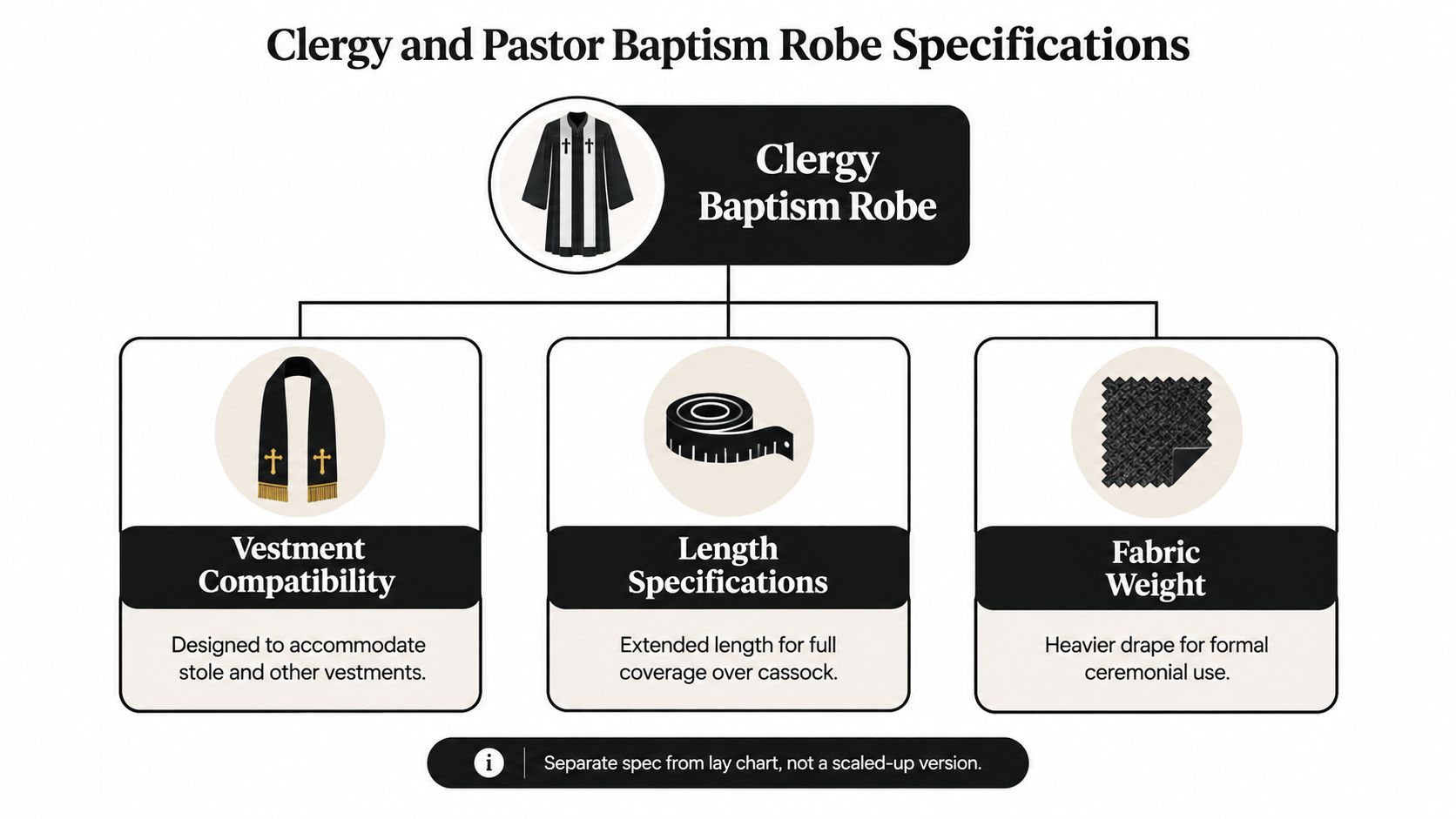
Specify these dimensions separately from a lay robe:
| Specification | Standard Clergy | XL Clergy |
|---|---|---|
| Shoulder width | Regular shoulder allowance over clerical clothing | Expanded shoulder allowance for broader frames and layers |
| Chest circumference | Room for a clerical shirt and light vestments | Additional room for cassock, stole, or broader torso |
| Center-back length | Mid-calf or ankle according to service practice | Extended coverage where body height and layering require it |
| Sleeve length | Sufficient reach for raised-arm blessing | Additional room through arm and shoulder |
| Neck opening | Stable over a clerical collar | Wider usable opening without loose gaping |
| Embroidery placement | Chest or shoulder location confirmed before production | Placement adjusted for stole and vestment overlap |
Tell the supplier whether the robe will be embroidered or unembroidered, where the stole will sit, and whether the pastor will wear a cassock underneath. The pastor baptism robes collection is a useful category reference, but a visiting pastor still needs a measurement record or a confirmed garment specification.
Fit, Length, and Movement Ease for Wet Garments
A baptism robe isn't a close-fitting apparel block. ASTM guidance treats body measurements as a baseline that must be interpreted with fabric type, movement ease, styling, and fit. The finished robe must support walking, arm elevation, sitting, stepping into water, and controlled movement while wet.
A candidate should pass a short fit test before the church accepts a group shipment:
- Walk: Take several steps, turn, and approach the font.
- Raise: Lift both arms overhead and extend them forward.
- Sit: Sit on a chair or changing bench without the neckline pulling.
- Bend: Bend at the waist and check that the back and chest remain covered.
- Step: Practice entering and leaving the baptistry area without standing on the hem.
Check the neckline, sleeve restriction, hem clearance, and opacity when wet. A robe can appear modest while dry but become clingy or revealing after immersion, so the fabric and cut must be evaluated together.
A robe that performs well in the water matters more than one that looks perfect on a hanger.
For shorter candidates, don't solve every problem by choosing a smaller width. That can create tightness through the chest and shoulders. Confirm whether the supplier can provide a shorter finished length or whether a controlled hem is appropriate.
For taller candidates, don't accept a robe with adequate chest room but insufficient sleeve or hem coverage. Height, chest, and finished length work as a system. If one measurement falls outside the chart, record it as a special-order question rather than hiding it under a familiar size label.
Bulk Ordering Robes for an Entire Church or Class
Bulk orders succeed when the church treats sizing as a data-collection task, not a guessing exercise. Create one worksheet per candidate, assign one person to review the measurements, and use the same between-sizes rule for everyone.
A dependable ordering workflow
- Build the roster: List candidates by name, height, chest or bust, waist, assigned cut, and notes about clothing underneath.
- Run a measurement day: Measure without shoes, use a relaxed tape, and record the numbers immediately.
- Review boundary cases: Flag anyone between height bands, outside the standard girth range, unusually tall, or likely to need custom embroidery.
- Create the size mix: Count each assigned size rather than ordering equal quantities of every label.
- Separate exceptions: Put custom lengths, embroidery, clergy specifications, and unusual proportions on a separate review list.
- Confirm the shipment: Ask whether the supplier can consolidate delivery for multiple campuses and whether replacements can ship separately if a problem affects only part of the order.
Use the wholesale baptismal robes resource when planning a larger purchase, then send the supplier a clean spreadsheet rather than a message that says “mostly mediums.”
| Candidate | Height | Chest | Assigned Size | Notes |
|---|---|---|---|---|
| Candidate 1 | ||||
| Candidate 2 | ||||
| Candidate 3 | ||||
| Candidate 4 | ||||
| Candidate 5 |
For children's ministries, review the roster again before placing a later order because growth can change the size mix. For a multi-campus church, designate one receiving location and label each campus bundle inside the shipment. Keep the worksheets with the purchase order so a replacement request can be matched to the original measurement.
Custom Sizing, Embroidery, and Lead Times
Use XL before requesting custom sizing when the candidate needs only more room through the torso. Custom measurements make sense when height and girth fall into different extremes, when sleeve or finished length is unusual, or when the robe must accommodate a specific vestment arrangement.
Write embroidery details into the order before production begins. Confirm the exact wording, capitalization, thread color, font, logo file, placement on the chest or shoulder, and whether the design will sit beneath a stole. A church emblem should be approved in its digitized form, not only as a small image attached to an email.
The embroidery stabilizer tips for baby clothes discuss lightweight-fabric considerations that are also useful when evaluating placement and support for delicate baptism garments.
| Decision | Default | Custom Option |
|---|---|---|
| Body fit | Standard or XL cut | Individual chest, waist, or shoulder measurements |
| Length | Published height-based length | Custom shoulder-to-hem length |
| Embroidery | Unembroidered robe | Church name, emblem, or approved wording |
| Placement | Standard chest position | Chest or shoulder placement around stole use |
| Clergy layering | Standard clergy specification | Cassock, cuffs, belt, or stole accommodation |
| Production timing | Stock availability confirmed before ordering | Supplier confirms production schedule in writing |
White baptism garments can be laundered and reused for multiple candidates and across services when cared for properly. An embroidered robe carrying a specific person's name is different. Treat it as a single-candidate garment unless the embroidery is a shared church identity.
Returns, Exchanges, and Reprint-Fit Policy
Don't wait until the morning of the service to inspect a shipment. Open the carton promptly, compare each robe with the assigned worksheet, and have candidates try on questionable sizes while the original packaging and order records are still available.
Before ordering, ask the supplier to explain four points in writing:
- Money-back guarantee: Confirm what qualifies, how the claim begins, and whether the robe must be unused.
- Exchange window: Ask how long an unused robe can be exchanged and whether the replacement size is subject to availability.
- Custom reprint fit: Confirm what happens if an embroidered robe arrives with incorrect sizing or production details.
- Bulk replacement handling: Ask whether the supplier can split-ship a small number of replacements rather than holding the entire order.
Keep the original measurements worksheet, purchase order, packing slip, and clear photos of a robe that is too short, too long, or too tight. Those records show whether the issue came from the recorded body measurement, the assigned chart size, or the finished garment.
For custom work, confirm whether buyer-paid customization costs are refundable and who covers return shipping. For a bulk shipment, document each affected robe by candidate name and size. A precise record speeds the conversation and prevents the church from repeating the original mistake.
Quick Reference and Related Resources
Print this card for the supply closet and use it at every measurement day.
Baptism robe sizing card
- Measure height without shoes.
- Measure chest or bust at the fullest point.
- Measure waist at the natural waist.
- Measure shoulder or neck to desired hem.
- Choose height first.
- Use chest, bust, waist, or hip as the tie-breaker.
- Choose the larger band when between heights.
- Choose XL when girth exceeds the standard range or clothing underneath makes the standard cut tight.
- Test walking, arm elevation, sitting, bending, and stepping before service day.
- Send unusual measurements, clergy layers, and embroidery details to customer support before ordering.
For category planning, review Adult Baptism Robes, Youth and Child Baptism Robes, Clergy and Pastor Baptism Robes, and baptism stoles. Pair those product pages with practical resources on care and storage, baptism outfit ideas, and bulk-order planning.
If families are collecting ceremony memories, a tool to gather christening photos easily can keep images organized without asking every guest to send files separately.
Baptism Robes provides height-based standard and XL options for adult, youth, children's, clergy, and pastor baptism clothing, along with custom embroidered styles and bulk-order support. Use the measurement rules in this guide, then visit Baptism Robes to compare robe categories and prepare a service-day order with confidence.